The science behind the film
One day, several places
To show as much Jurassic life as possible, the film brings together animals whose fossils come from different regions and from slightly different moments of the Middle and Late Jurassic. Most lived around 155 to 145 million years ago, but a few, such as Leedsichthys and Yi qi, are somewhat older, from about 165 to 160 million years ago. In reality no single valley held all of them at once. Each animal’s page gives its exact age and where its fossils were found.
The floodplains: Morrison and Lourinhã
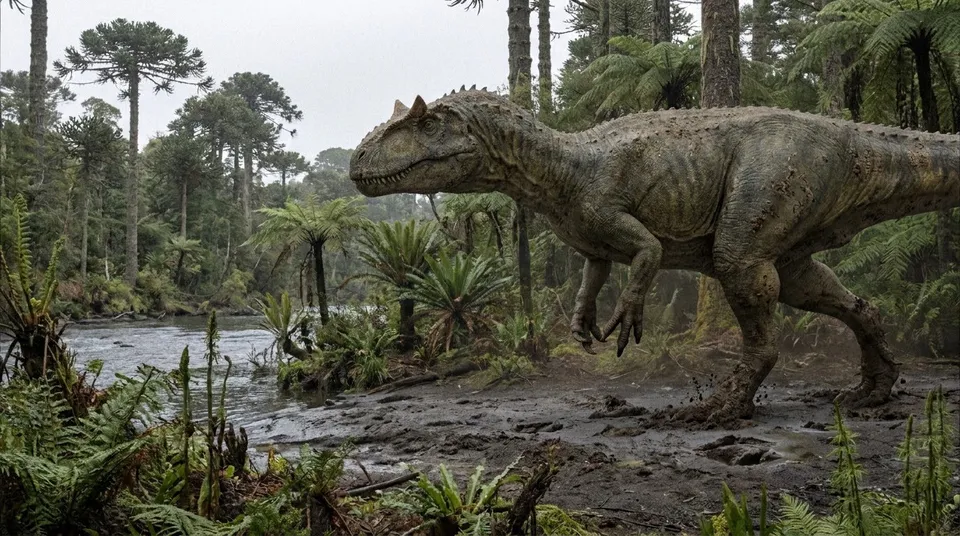
The land scenes are based mainly on two famous rock formations. The Morrison Formation of the western United States preserves a vast Late Jurassic floodplain crossed by rivers, with a warm climate and a long dry season. It has produced Allosaurus, Ceratosaurus, Torvosaurus, Stegosaurus, Diplodocus, Brachiosaurus and many more.
The Lourinhã Formation in western Portugal is the same age and shares many of the same animals, because the North Atlantic was then only a narrow sea. Portuguese finds include Torvosaurus, Allosaurus and Stegosaurus, as well as the eggs and embryos of Torvosaurus.
The lagoon: Solnhofen
The coastal lagoon scenes draw on the Solnhofen limestone of southern Germany, laid down in warm, salty lagoons behind reefs. Its fine-grained rock preserved Archaeopteryx with its feathers, the pterosaur Rhamphorhynchus with its wing membranes, the small dinosaur Compsognathus, horseshoe crabs, insects and the angel shark Pseudorhina.
The sea: Oxford Clay and Kimmeridge Clay
The ocean scenes are based on the rich marine rocks of England, especially the Oxford Clay and the Kimmeridge Clay. They have produced ichthyosaurs such as Ophthalmosaurus, the giant fish Leedsichthys, sea crocodiles such as Dakosaurus and Metriorhynchus, and pliosaurs including Liopleurodon and Pliosaurus, together with countless ammonites and belemnites.
How we reconstruct the animals
Skeletons tell us an animal’s size, proportions, how it stood and moved, and often what it ate. Skin impressions, feather traces and rare soft-tissue fossils add detail for some species. Colour is almost never preserved, so most colours in the film are informed guesses based on living animals in similar environments. Where scientists disagree, for example about how fast a Diplodocus tail could move, the film avoids presenting one side as fact.
The film’s scenes are AI-assisted reconstructions based on published evidence. Some behaviour and colours are informed interpretation.
Read the complete guide to the Jurassic Period →
Sources
- Foster (2020). Jurassic West: The Dinosaurs of the Morrison Formation and Their World. 2nd ed. Indiana University Press.
- Araújo et al. (2013). Filling the gaps of dinosaur eggshell phylogeny: Late Jurassic theropod clutch with embryos from Portugal. Scientific Reports 3.
- Barthel, Swinburne & Conway Morris (1990). Solnhofen: A Study in Mesozoic Palaeontology. Cambridge University Press.
- Martill & Hudson (1991). Fossils of the Oxford Clay. Palaeontological Association.