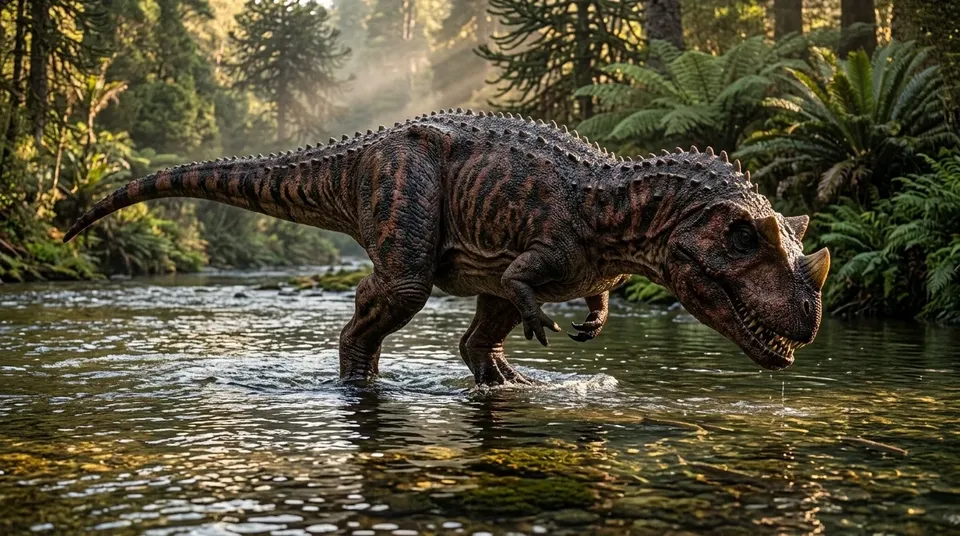
The horned hunter
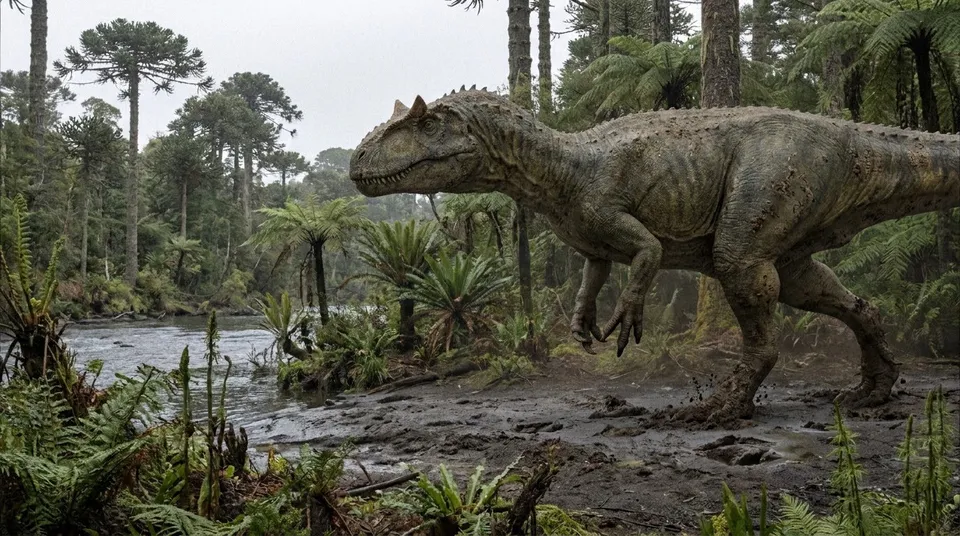
Ceratosaurus was a medium-sized predatory dinosaur that lived in western North America and Portugal in the Late Jurassic, at the same time and in the same places as the larger Allosaurus. Othniel Charles Marsh named it in 1884 after the blade-like horn on its snout.
Most individuals were around 5 to 6 metres long, and the largest specimens may have reached about 7 metres. It was rarer than Allosaurus, which suggests it filled a slightly different role in the ecosystem.
A body unlike other theropods
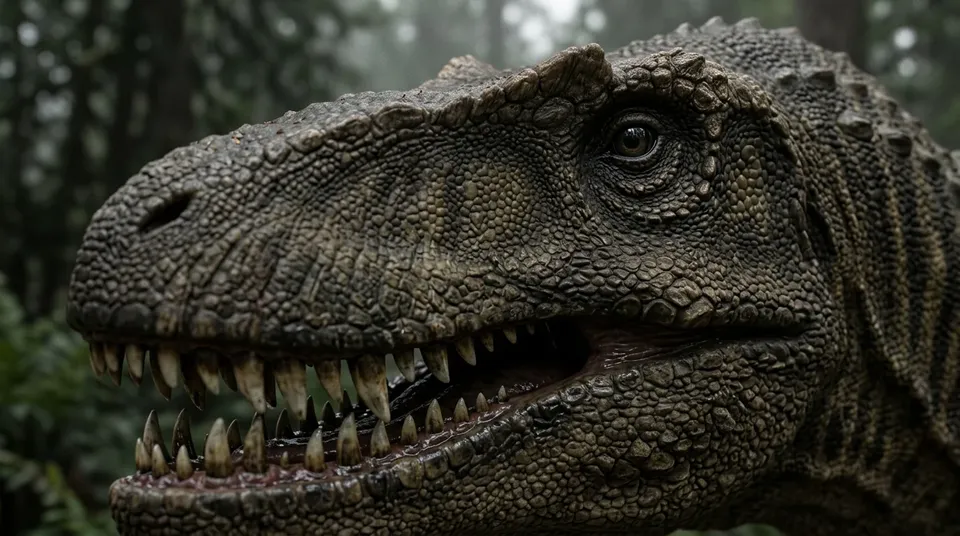
Besides the nose horn, Ceratosaurus had a smaller bony ridge in front of each eye and, unusually for a meat-eating dinosaur, a line of small bony plates running down the middle of its back. Its upper teeth were extremely long for the size of its skull, curved and serrated like knives.
Its arms were short, but it still had four fingers on each hand, an older feature that most later predators lost. The horn was thin and probably too fragile to be a weapon; most researchers think it was for display.
Living beside Allosaurus
How two big predators shared the same floodplains is a question palaeontologists still argue about. One idea is that Ceratosaurus, with its deep tail and long teeth, spent more time around rivers and wetlands, perhaps taking fish, crocodiles and other prey near the water, while Allosaurus hunted on drier ground. It is an interesting hypothesis, but the evidence for it is limited.
From Garden Park to Lourinhã
The first skeleton was dug up in 1883 at Garden Park, near Cañon City in Colorado, one of the quarries at the centre of the so-called Bone Wars between Marsh and his rival Edward Drinker Cope. It was remarkably complete, and for decades it was the main source of information about the animal.
More specimens came to light in the twentieth century, including large individuals from Utah at the Cleveland-Lloyd Dinosaur Quarry. In 2000 the description of Ceratosaurus bones from the Lourinhã Formation in Portugal showed that it also lived on the European side of the young Atlantic, just like Allosaurus and Torvosaurus. Some researchers recognise up to three species, but others think the differences between them reflect age and individual variation, so how many species there really were remains debated.
An early branch of a long-lived family
Ceratosaurus gives its name to the Ceratosauria, a branch of meat-eating dinosaurs that split off early from the line leading to Allosaurus, tyrannosaurs and birds. The group was very successful. In the Cretaceous its best-known members, the abelisaurids, became top predators in South America, Africa, Madagascar and India. Carnotaurus from Argentina, with its two bull-like horns and tiny arms, and Majungasaurus from Madagascar are examples.
Ceratosaurus already shows features of that family: a deep skull, short arms and ornament on its head. Looking at it is a little like seeing an early draft of the horned predators that would rule the southern continents tens of millions of years later.
Measurements are estimates based on fossils and can change as new specimens are found. Illustrations on this page are artist reconstructions, not photographs.
 See it in our documentaryA Day in the Jurassic21 min · chapters, the science behind the film and sources
Sources
- Madsen & Welles (2000). Ceratosaurus (Dinosauria, Theropoda): a revised osteology. Utah Geological Survey Miscellaneous Publication 00-2.
- Carrano & Sampson (2008). The phylogeny of Ceratosauria (Dinosauria: Theropoda). Journal of Systematic Palaeontology 6(2).
- Mateus et al. (2006). The large theropod fauna of the Lourinhã Formation (Portugal) and its similarity to the Morrison Formation.