Where our facts come from
Our articles are based on peer-reviewed scientific papers, books by palaeontologists, and the published work of natural history museums. Each article ends with a list of the main sources used, with links wherever they are freely available. We prefer the most recent research: when a new study changes what we know, such as the 2026 re-evaluation of Liopleurodon’s size, we update the article.
How we handle numbers and uncertainty
- Sizes and weights of extinct animals are estimates. We give ranges and say when estimates vary between studies.
- Dates follow the International Chronostratigraphic Chart and are rounded where appropriate.
- When scientists disagree, for example over whether a species is valid, we describe the debate rather than presenting one view as settled.
- Popular myths are clearly marked as myths and contrasted with the evidence.
Illustrations and films
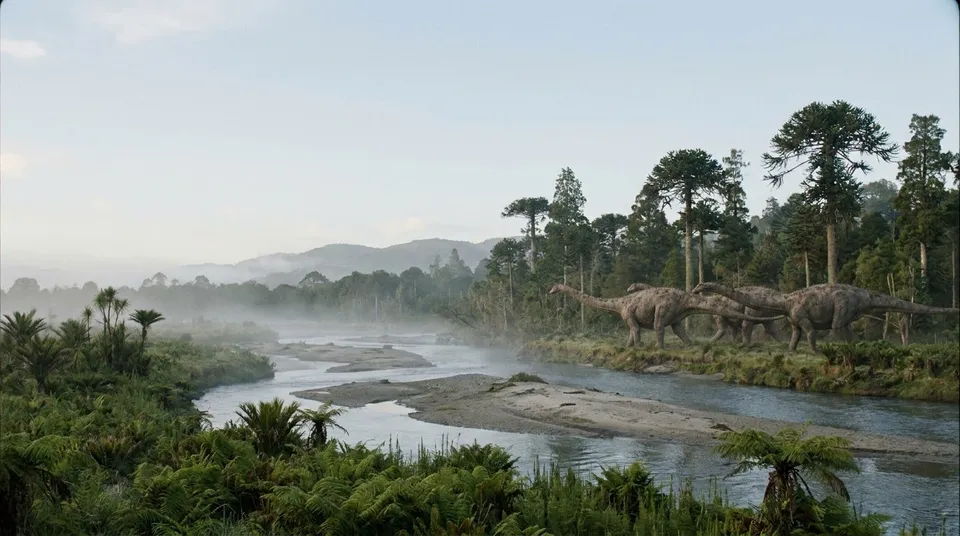
No one has ever photographed a living dinosaur. Our images and documentary scenes are reconstructions made with the help of AI image and video tools, directed by us and based on fossil evidence: skeletons, skin impressions, trackways and the plants and environments preserved in the same rocks. Colours, behaviour and some details are informed speculation. Every illustration is labelled as an artist reconstruction.
Our documentaries sometimes bring together animals from different regions, or from slightly different moments of the same period, to show more of that world. Each animal’s article gives its exact age and where its fossils were found.
Writing and review
We use digital tools, including AI assistants, to help research and draft text. Every article is then checked against its sources and reviewed before publication. We do not publish claims we cannot trace to a reliable source.
Corrections
If you find an error, please contact us. Significant corrections are made promptly, and the article’s sources are updated.