A walking fortress of the Jurassic
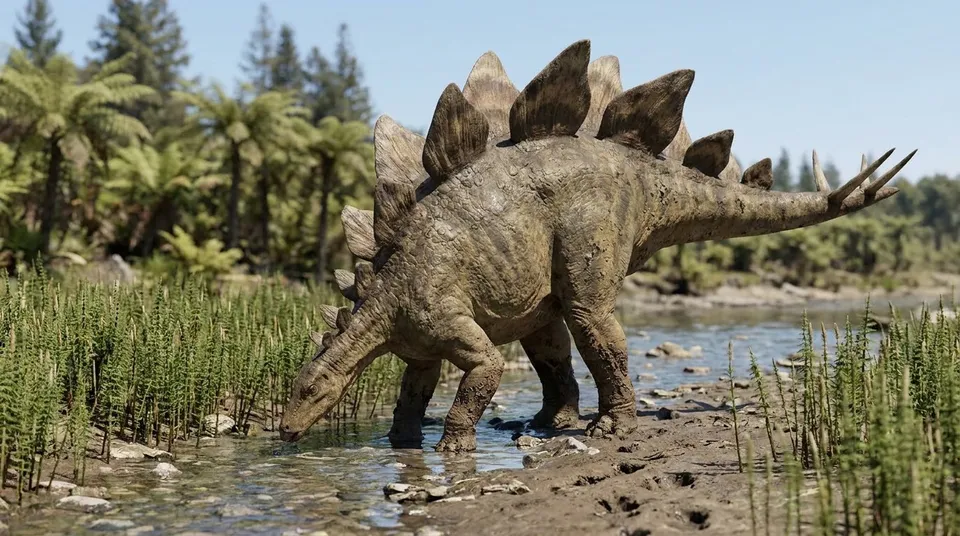
Stegosaurus was a large, four-legged plant-eater that lived alongside Allosaurus in western North America between about 155 and 145 million years ago. Its name, given by Othniel Charles Marsh in 1877, means “roof lizard”: Marsh first thought the plates lay flat along its back like roof tiles.
A Stegosaurus fossil has also been described from Portugal, showing that the animal lived on both sides of the young North Atlantic.
Sophie: the most complete Stegosaurus
The best skeleton ever found is a young adult nicknamed Sophie, discovered in Wyoming and on display at the Natural History Museum in London since 2014. It is about 85% complete, roughly 5.6 metres long, and scientists estimated it weighed around 1.6 tonnes. Fully grown Stegosaurus were bigger, with the largest individuals reaching about 9 metres.
Sophie showed that the front legs were much shorter than the back legs, giving the animal a low head and high hips. It was a slow walker, not a runner, and its small, peg-like teeth were suited to cropping low ferns, horsetails and cycads rather than grinding tough food.
What were the plates for?
Stegosaurus had two rows of large, flat, bony plates running along its neck, back and tail, arranged in an alternating pattern rather than in neat pairs. Sophie has 19 of them.
Their purpose is still debated. The plates were thin and full of blood-vessel channels, so they were probably not strong armour. The leading ideas are display, helping individuals recognise their own species and attract mates, and heat control, warming up or shedding heat through blood flowing near the surface. They may well have done both.
The thagomizer: a deadly tail
At the end of the tail were four long bony spikes. Palaeontologists call this arrangement a thagomizer, a word borrowed from a 1982 Far Side cartoon that scientists liked so much they kept using it.
The tail was a real weapon. About one in ten Stegosaurus spikes that have been studied are broken and healed at the tip, and an Allosaurus tail bone from Utah has a hole that a Stegosaurus spike fits almost perfectly. A swing of that tail could injure even the largest predator of its time.
The “second brain” that never existed
Stegosaurus had one of the smallest brains for its body size of any dinosaur, weighing only about 80 grams. Early palaeontologists found a large space in the spinal canal above the hips and suggested it held a second brain that controlled the back legs and tail.
Today that idea has been dropped. Birds, the living relatives of dinosaurs, have a similar space filled with a glycogen body, a store of energy-rich tissue, and Stegosaurus probably had the same. One small brain was enough for a slow, armoured plant-eater to thrive for millions of years.
Closer to us than to T. rex
Stegosaurus and Tyrannosaurus never met. Stegosaurus lived about 150 million years ago and T. rex about 68 to 66 million years ago, a gap of more than 80 million years. That is longer than the time that separates T. rex from us.
Measurements are estimates based on fossils and can change as new specimens are found. Illustrations on this page are artist reconstructions, not photographs.
 See it in our documentaryA Day in the Jurassic21 min · chapters, the science behind the film and sources
Sources
- Natural History Museum, London. Stegosaurus brought to life (Sophie).
- Maidment et al. (2015). The postcranial skeleton of an exceptionally complete individual of the plated dinosaur Stegosaurus stenops. PLOS ONE 10(10):e0138352.
- Carpenter et al. (2005). Evidence for predator–prey relationships: examples for Allosaurus and Stegosaurus.
- Escaso et al. (2007). Ancient proto-North Atlantic: Stegosaurus from Portugal. Naturwissenschaften 94.