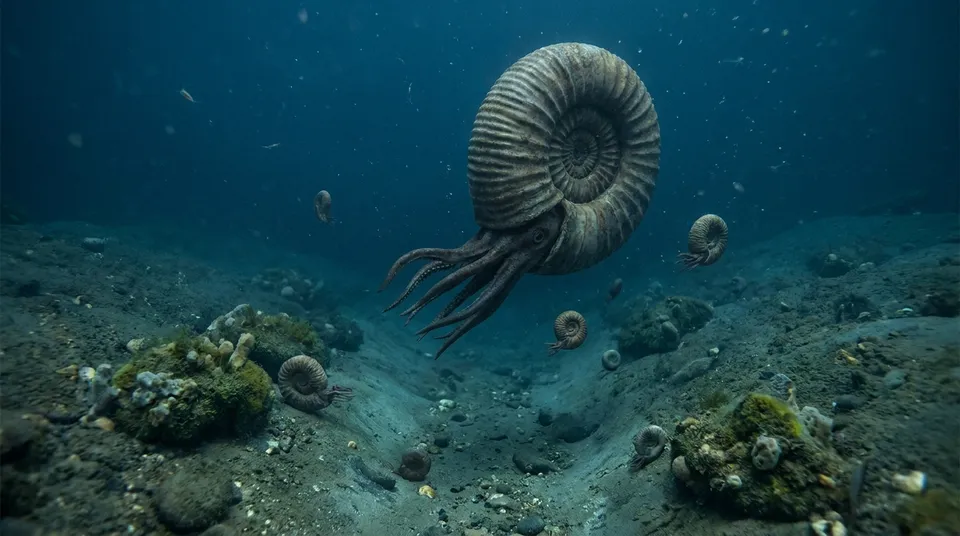
A giant among ammonites
Ammonites were sea animals with a soft body and tentacles living inside a coiled, chambered shell, distant relatives of today’s squid, octopus and nautilus. Titanites is one of the largest found in Britain: its shells, from the Portland Stone of Dorset, often measure more than a metre across.
Portland Stone is a famous building limestone, and fossil Titanites can be seen built into walls, buildings and gardens on the Isle of Portland and along the Jurassic Coast.
How ammonites lived
The animal lived in the last, largest chamber of its shell. By adjusting the gas and liquid in the older chambers, it could control its buoyancy and float in the water. Ammonites evolved so quickly and were so widespread that geologists use them to date rocks precisely.
They survived for more than 300 million years, through several mass extinctions, before disappearing with the dinosaurs 66 million years ago.
Ammonites as a geological clock
Each ammonite species lived for a relatively short time, often less than a million years, and many spread across the world’s oceans. That makes them excellent markers for dating rocks. Geologists divide the Jurassic and Cretaceous into ammonite zones, each named after a typical species, and Titanites gives its name to one of the zones of the latest Jurassic in England.
The walls between the shell chambers met the outer shell along complex, frilled lines, called sutures. Their pattern differs between species and is one of the main features used to identify ammonites.
Fossils in famous buildings
Titanites comes from the Portland Stone, a pale limestone quarried on the Isle of Portland in Dorset for centuries. After the Great Fire of London in 1666, Christopher Wren chose Portland Stone for St Paul’s Cathedral, and it was later used for many other famous buildings. Giant ammonites can still be seen in walls and quarries on the island.
Titanites was big, but not the biggest. The record belongs to Parapuzosia seppenradensis, a Late Cretaceous ammonite from Germany found in 1895 with a shell about 1.8 metres across.
What did ammonites eat?
Ammonite soft bodies are almost never preserved, so their diet is hard to know. A 2011 study of the ammonite Baculites used X-ray imaging to find tiny jaws and teeth inside the shell, together with remains of small crustaceans, suggesting that at least some ammonites fed on plankton. Ammonites survived several mass extinctions but finally disappeared 66 million years ago, while their cousins the nautiluses survived.
Measurements are estimates based on fossils and can change as new specimens are found. Illustrations on this page are artist reconstructions, not photographs.
 See it in our documentaryA Day in the Jurassic21 min · chapters, the science behind the film and sources