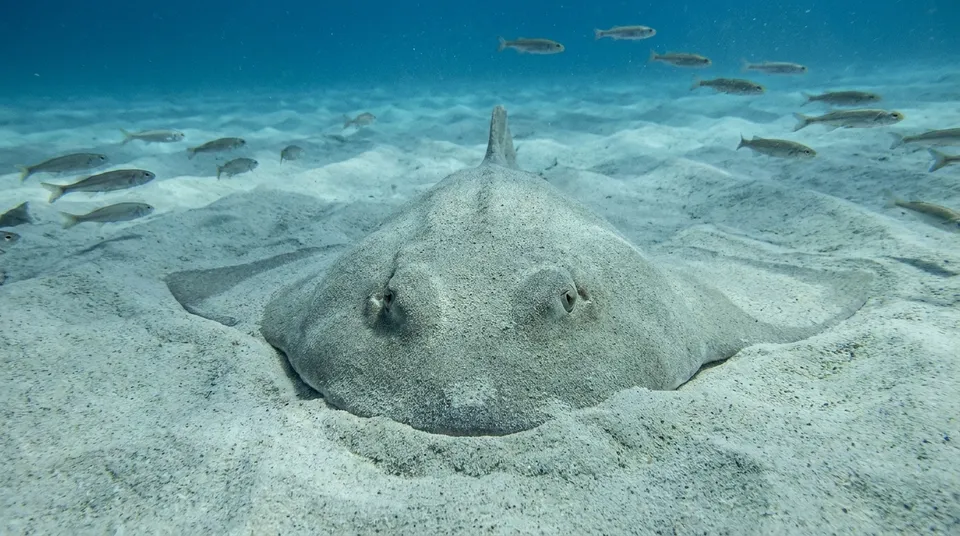
An ancient angel shark
Pseudorhina is one of the oldest known angel sharks, a group of flattened sharks that look a little like rays. Beautifully preserved skeletons, sometimes with the outline of the body, come from the Late Jurassic limestones of Solnhofen in Bavaria, about 150 million years old.
Hunting from the seabed
Like modern angel sharks, Pseudorhina probably buried itself in sand on the lagoon floor with only its eyes showing, then lunged upward to snap up fish and other small animals swimming overhead. This body plan and hunting style worked so well that angel sharks have changed remarkably little in 150 million years.
A shark disguised as a ray
Angel sharks look like rays, but there are clear differences. In rays, the large pectoral fins are fused to the sides of the head and the mouth and gill slits are on the underside. In angel sharks the mouth sits at the front of the head, the gill slits are on the sides, and the pectoral fins are separate from the head.
Pseudorhina already had this design 150 million years ago. Its eyes sat on top of its head, its mouth could open quickly, and its body was perfectly shaped for lying flat on the bottom. Studies of the fossils show that the basic angel shark body plan has barely changed since the Late Jurassic, which means it was a solution that worked from the beginning.
Angel sharks today
Modern angel sharks of the genus Squatina live on sandy and muddy bottoms in many coastal seas. Their lifestyle on the seabed, in shallow water, has made them very vulnerable to bottom trawling and coastal fishing. The common angel shark of the north-east Atlantic and the Mediterranean, once abundant, is now listed as Critically Endangered, and the Canary Islands are one of its last strongholds.
A group of animals that survived for 150 million years, including the mass extinction at the end of the Cretaceous, is now under pressure in just a few human generations. Fossils like Pseudorhina show how old and successful that design is.
Why Solnhofen preserves so much
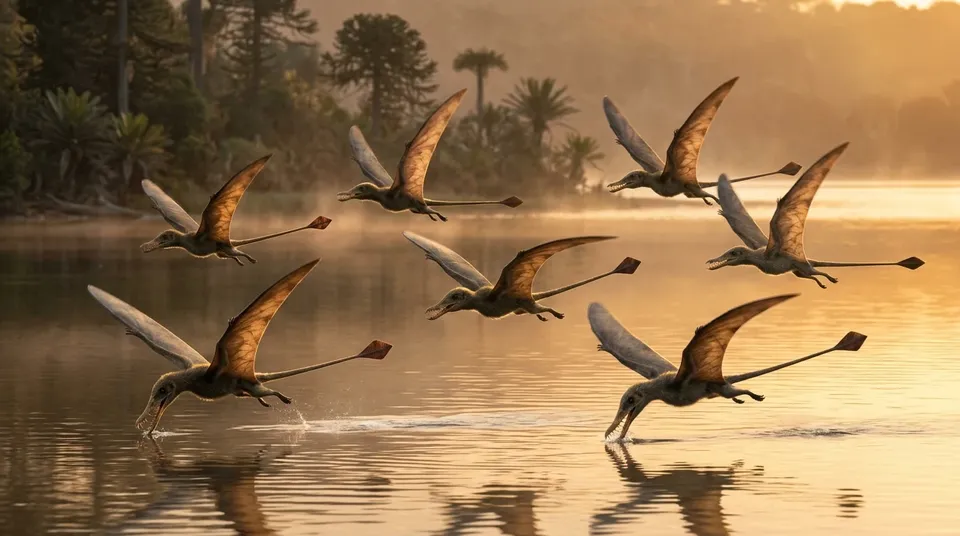
The Solnhofen limestone formed in shallow lagoons behind reefs. The bottom water was very salty and low in oxygen, so scavengers and burrowing animals could not live there. When a shark, a pterosaur or an insect sank, its body was buried by fine lime mud without being torn apart. That is why the same rocks also preserve Archaeopteryx feathers and the wing membranes of Rhamphorhynchus.
Measurements are estimates based on fossils and can change as new specimens are found. Illustrations on this page are artist reconstructions, not photographs.
 See it in our documentaryA Day in the Jurassic21 min · chapters, the science behind the film and sources