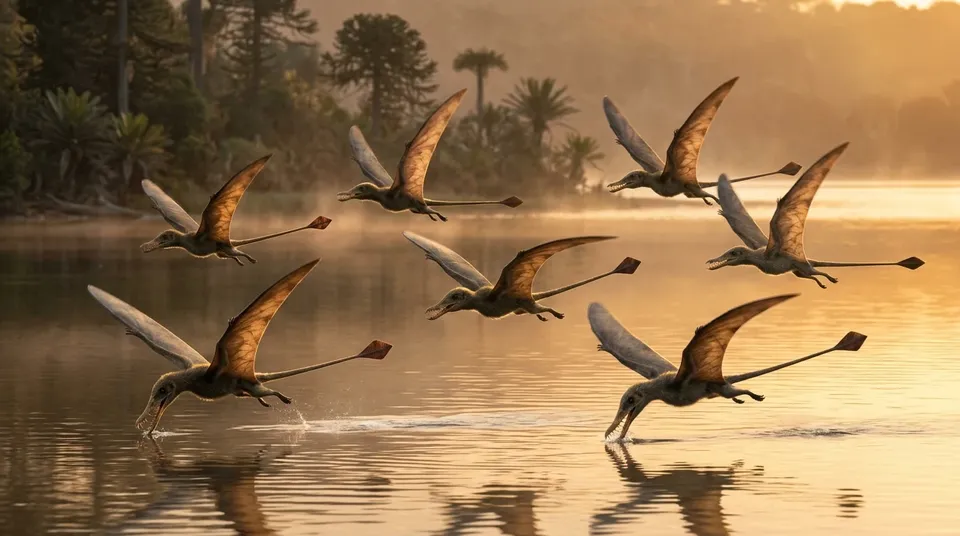
A fishing pterosaur
Rhamphorhynchus was a pterosaur, a flying reptile, that lived around the Solnhofen lagoons of southern Germany about 150 million years ago. Pterosaurs were cousins of dinosaurs, not dinosaurs themselves. Their wings were made of skin stretched from an enormously long fourth finger to the legs.
Its long jaws were lined with needle-like teeth that pointed forward, a perfect trap for slippery fish. Fossils with fish preserved in the stomach confirm its diet. The largest individuals had wingspans of about 1.8 metres, though most were smaller.
The tail with a rudder
Rhamphorhynchus belonged to the early, long-tailed pterosaurs. Its stiff tail ended in a diamond-shaped vane of skin, which may have helped steering in flight. Later pterosaurs of the Cretaceous lost the long tail.
Because so many specimens of different sizes have been found, scientists have been able to study how Rhamphorhynchus grew from small juveniles into adults.
Caught in the act
One extraordinary Solnhofen slab preserves a Rhamphorhynchus with a large predatory fish, Aspidorhynchus, attached to its wing. The fish seems to have grabbed the pterosaur at the water’s surface, become tangled, and both died and sank together. It is a rare snapshot of a moment of predation 150 million years ago.
How pterosaurs flew
A pterosaur wing was very different from a bird’s or a bat’s. A single, hugely elongated fourth finger supported a membrane of skin and muscle that stretched back to the legs. The membrane was strengthened by thin fibres, which kept it taut in flight. A small extra wrist bone, the pteroid, supported a smaller membrane in front of the arm.
Many researchers think pterosaurs took off by vaulting on all four limbs, using their powerful arms like a pole vaulter. Rhamphorhynchus had a wingspan of up to about 1.8 metres in the largest individuals, and long, forward-pointing teeth that interlocked when the jaws closed, a design well suited to catching slippery fish.
A growth series from the lagoons
Hundreds of Rhamphorhynchus specimens are known, of very different sizes. Early palaeontologists divided them into several species. A study in 1995 showed that most of them form a single growth series: small, medium and large individuals of one species, Rhamphorhynchus muensteri, at different ages.
The Solnhofen lagoons, where they lived, had warm, salty water near the surface and stagnant, oxygen-poor water at the bottom. Animals that sank there were not eaten or scattered, which is why the area preserved so many delicate fossils, including wing membranes and the stomach contents of some Rhamphorhynchus, which contained fish.
Measurements are estimates based on fossils and can change as new specimens are found. Illustrations on this page are artist reconstructions, not photographs.
 See it in our documentaryA Day in the Jurassic21 min · chapters, the science behind the film and sources