Half bird, half dinosaur
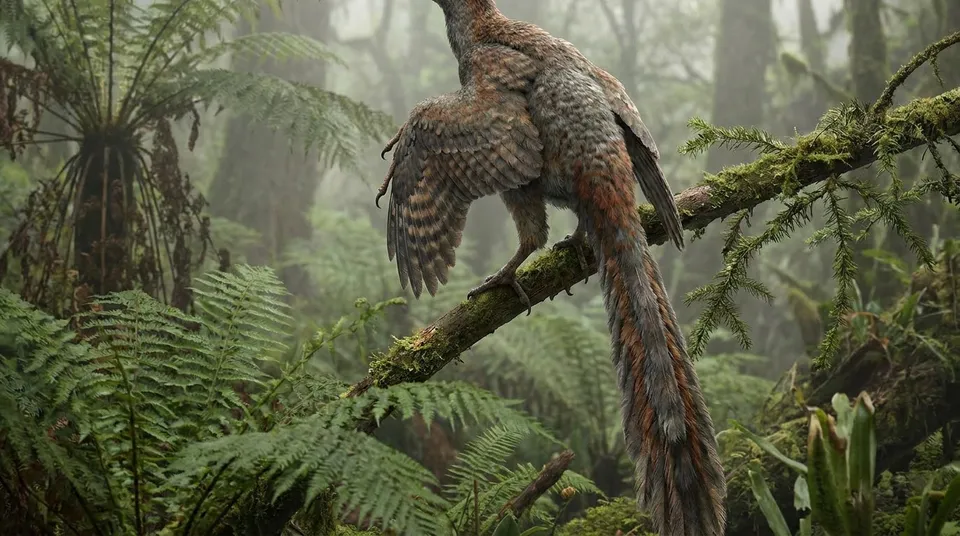
Archaeopteryx lived about 150 million years ago on a group of small, hot islands in a shallow tropical sea that covered what is now southern Germany. It was roughly the size of a raven, with broad feathered wings, a wishbone and flight feathers shaped like those of modern flying birds.
But it also had features no living bird has: jaws full of small teeth, three clawed fingers on each wing and a long tail supported by a chain of bones. It shows, better than almost any other fossil, that birds evolved from small meat-eating dinosaurs.
Perfect timing
In 1861 a single fossil feather was described from the fine limestone quarried near Solnhofen in Bavaria, and the name Archaeopteryx, “ancient wing”, was given to it. The same year, a nearly complete skeleton with feathers appeared and was bought by the British Museum in London.
It arrived just two years after Charles Darwin published On the Origin of Species. An animal that mixed reptile and bird features was exactly the kind of in-between form his theory predicted, and Archaeopteryx quickly became famous.
Only about a dozen skeletons
Archaeopteryx is extremely rare. Around a dozen skeletons are known, all from the limestone quarries of the Altmühl valley in Bavaria. One specimen, found in 1855 and long counted as an Archaeopteryx, was reclassified in 2017 as a different animal. The oldest specimen, described in 2018, comes from rocks near Schamhaupten.
The Solnhofen limestone formed from fine mud on the bottom of still, salty lagoons with little oxygen. Few scavengers lived there, so the bodies that sank were buried quietly, preserving even the outlines of feathers.
Could it fly?
Its wings and asymmetrical flight feathers suggest that Archaeopteryx could fly, at least over short distances. How well it flew is still debated. It lacked the large keeled breastbone that anchors the powerful flight muscles of modern birds, so it was probably a weaker flier, perhaps flapping and gliding between trees and the ground.
Is it really the “first bird”?
Archaeopteryx is often called the first bird or the missing link. Since the 1990s, many feathered dinosaurs have been found, especially in China, and some are similar in age or older. Archaeopteryx is best seen as one early member of a wide group of feathered, bird-like dinosaurs, not as the single ancestor of all birds.
Measurements are estimates based on fossils and can change as new specimens are found. Illustrations on this page are artist reconstructions, not photographs.
 See it in our documentaryA Day in the Jurassic21 min · chapters, the science behind the film and sources