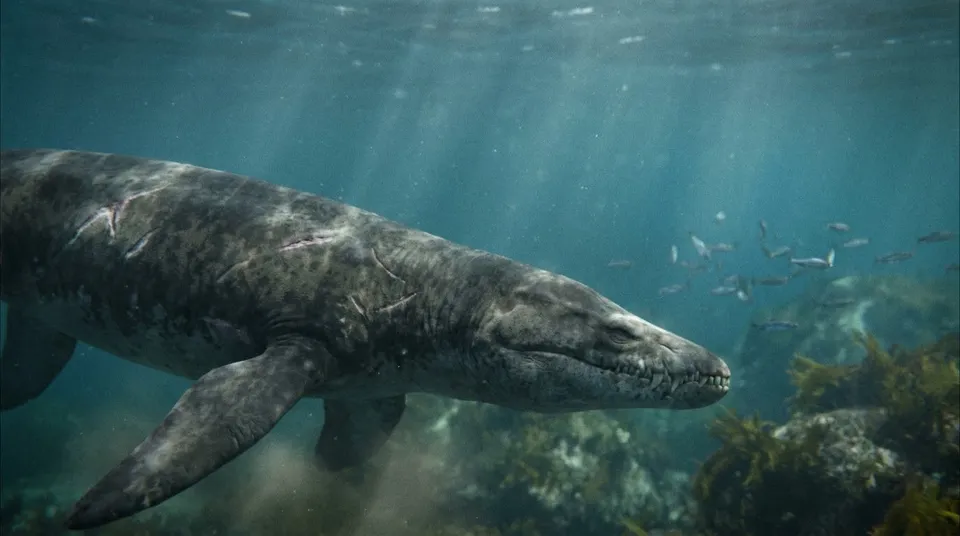
Not a dinosaur, a sea reptile
Liopleurodon was a pliosaur, a short-necked member of the plesiosaur family of marine reptiles. It was not a dinosaur: it belonged to a separate group of reptiles that returned to the sea and swam with four large flippers.
It lived in the Middle Jurassic, about 165 million years ago, in warm, shallow seas that covered much of what is now England and northern France. Its best fossils come from the Oxford Clay around Peterborough, where brickworks dug up huge quantities of Jurassic clay in the late 1800s and early 1900s.
Named from a single tooth
The French palaeontologist Henri Émile Sauvage named Liopleurodon in 1873 from one large tooth found near Boulogne-sur-Mer. The name means “smooth-sided tooth”, and ferox means “fierce”. Later, a local farmer and collector, Alfred Leeds, gathered complete skeletons and skulls from the Peterborough brick pits that are now in museums across Europe and North America.
How big was it really?
In 1999 the BBC series Walking with Dinosaurs showed Liopleurodon as a 25-metre giant, and the number spread around the world. It was based on scattered fragments of very large pliosaurs that cannot be confidently linked to Liopleurodon.
In 2026 researchers at the University of Portsmouth re-examined all 37 specimens assigned to the species, using a near-complete skull and two very well-preserved skeletons. They found that the largest Liopleurodon reached just over 8 metres. Its head was enormous for its body, about a quarter of its total length, which let it tackle relatively large prey. Some related pliosaurs of the Late Jurassic grew to around 12 metres.
Ruler of the Oxford Clay sea
Even at 8 metres, Liopleurodon was the largest animal in its ecosystem and sat at the top of the food chain. Its long, conical teeth were made for gripping slippery prey such as fish, squid-like cephalopods and other marine reptiles, including ichthyosaurs and smaller plesiosaurs. Pliosaurs like it remained the top predators of the oceans for roughly 80 million years, until mosasaurs replaced them in the Late Cretaceous.
The Oxford Clay sea
Liopleurodon lived in a warm, shallow sea that covered much of what is now England and northern France about 165 to 160 million years ago. Its fossils, and those of its neighbours, come mainly from the Oxford Clay, a layer of dark mudstone dug for brickmaking around Peterborough.
That sea was crowded with life. Ichthyosaurs like Ophthalmosaurus, long-necked plesiosaurs, sea crocodiles such as Metriorhynchus, the giant filter-feeding fish Leedsichthys and huge numbers of squid-like belemnites and ammonites all lived there. Liopleurodon sat at the top of this food web, alongside other pliosaurs such as Simolestes and Peloneustes.
Measurements are estimates based on fossils and can change as new specimens are found. Illustrations on this page are artist reconstructions, not photographs.
 See it in our documentaryA Day in the Jurassic21 min · chapters, the science behind the film and sources