When was the Cretaceous?
The Cretaceous Period began about 145 million years ago and ended 66 million years ago. At about 79 million years, it is the longest period of the Mesozoic Era, and longer than the entire time that has passed since the dinosaurs died out.
The Belgian geologist Jean d’Omalius d’Halloy named it in 1822. The name comes from creta, Latin for chalk. Thick layers of chalk, like the White Cliffs of Dover, formed in Cretaceous seas from the microscopic skeletons of countless plankton.
Unlike most periods, the Cretaceous is divided into only two epochs, the Early and the Late Cretaceous.
Its two epochs
Geologists split the Cretaceous into parts called epochs. Tap through them below.
Flowering plants appear. Feathered dinosaurs thrive in China’s Jehol forests, Iguanodon roams Europe, and Africa and South America begin to separate.
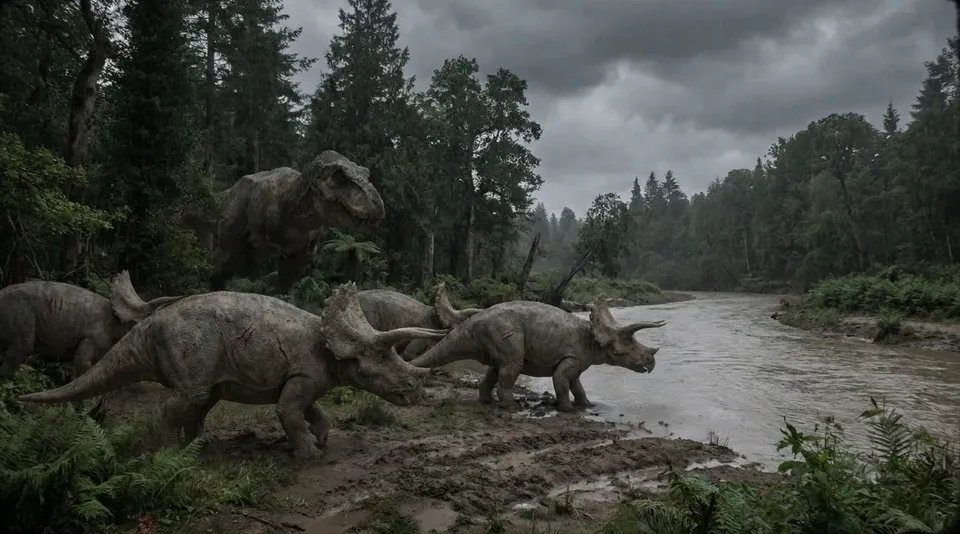
The age of Tyrannosaurus, Triceratops, Spinosaurus and giant titanosaurs. Seas are high and mosasaurs rule the oceans, until the asteroid strikes.
What the world looked like
During the Cretaceous the pieces of Pangaea drifted further apart. South America and Africa separated as the South Atlantic opened, India broke away and moved north, and Australia and Antarctica slowly parted.
It was a greenhouse world, at times one of the warmest in the last few hundred million years, with no permanent ice caps. Sea levels were much higher than today. In the Late Cretaceous a shallow sea, the Western Interior Seaway, ran from the Gulf of Mexico to the Arctic and split North America in two: Laramidia in the west, home to T. rex, and Appalachia in the east.
Plants: the arrival of flowers
The biggest change in plant life was the rise of flowering plants, the angiosperms. The first appear in Early Cretaceous rocks, and by the end of the period they were common in many habitats, alongside conifers, cycads, ginkgos and ferns. Magnolias, water lilies and early relatives of plane trees grew in Cretaceous forests.
Grasses also appear in this period. Fossil grass particles found in the dung of plant-eating dinosaurs from India show that grasses existed by the Late Cretaceous, but they did not form wide grasslands until millions of years after the dinosaurs had gone.
Animals of the Cretaceous
The Cretaceous produced some of the most famous dinosaurs of all, and also the biggest. Feathered dinosaurs were widespread, birds diversified, and the first snakes and many modern groups of insects appeared. In the oceans, mosasaurs and plesiosaurs hunted alongside sharks and ammonites.
Up to about 12 m long and 8 tonnes or more, with one of the strongest bites of any land animal. Lived about 68–66 million years ago in western North America.
Read the full profileSpinosaurusSpinosaurus aegyptiacusA long-snouted predator with a tall sail on its back, from North Africa about 95 million years ago. It fed largely on fish; how much time it spent in water is debated.
Read the full profileA feathered predator about the size of a turkey from Mongolia, about 75 million years ago, much smaller than in the films.
A three-horned plant-eater up to about 9 m long, one of the last non-bird dinosaurs, living alongside T. rex.
A titanosaur from Argentina, about 95 million years ago, often estimated at 30–35 m long. One of the largest land animals ever.
The famous armoured dinosaur with a bony tail club, from the very end of the Cretaceous.
A large plant-eater from the Early Cretaceous of Europe with a spiky thumb, one of the first dinosaurs ever described.
A mosasaur of about 9–10 m from the Western Interior Seaway. Mosasaurs were giant marine lizards related to monitor lizards and snakes.
Read the full profileA plesiosaur with an extraordinarily long neck: about 7 m of its roughly 10 m length.
A mackerel shark as big as a great white, whose teeth are found embedded in mosasaur bones.
Read the full profileXiphactinusXiphactinus audaxA 5-metre bony fish with fang-like teeth. One fossil holds a 2-metre fish swallowed whole.
Read the full profileA giant sea turtle more than 4 m long, the largest turtle known.
A giant pterosaur from Texas with an estimated wingspan of around 10 m, one of the largest flying animals ever.
A toothless pterosaur with a long head crest and a wingspan of up to about 6 m, common over the Western Interior Seaway.
A seabird about the size of a pigeon that still had teeth, a link between early birds and modern ones.
Animals with a “Read the full profile” link have their own illustrated article. More are added with each new documentary.
Where its fossils are found
- Hell Creek Formation, Montana and the Dakotas, USA. The last chapter of the dinosaurs, with T. rex, Triceratops and the rocks that record the extinction itself.
- Kem Kem beds, Morocco. River deposits about 95 million years old, home to Spinosaurus and other giant predators.
- Gobi Desert, Mongolia. Velociraptor, Protoceratops, dinosaur nests and the famous “fighting dinosaurs” fossil.
- Niobrara Chalk, Kansas, USA. The floor of the Western Interior Seaway, full of mosasaurs, Pteranodon and giant fish.
- Jehol Biota, north-east China. Early Cretaceous lake beds that preserve feathered dinosaurs, early birds and some of the first flowers.
- Bernissart, Belgium. A coal mine where dozens of Iguanodon skeletons were found in 1878.
How the Cretaceous ended
The Cretaceous ended 66 million years ago, when an asteroid about 10 kilometres wide hit what is now the Yucatán Peninsula in Mexico, leaving the Chicxulub crater. The impact threw dust, soot and sulphur into the atmosphere, blocking sunlight, collapsing food chains and causing a sudden global winter.
The clue that revealed it was a thin layer of clay rich in iridium, an element rare on Earth but common in asteroids, found around the world at the boundary. Massive volcanic eruptions in India, the Deccan Traps, were also under way at the time and added to the stress on life.
About three-quarters of all species disappeared, including all non-bird dinosaurs, pterosaurs, mosasaurs, plesiosaurs and ammonites. Birds, mammals, crocodiles, turtles and many other groups survived, and mammals went on to inherit the Earth.
Key points for your test
- The Cretaceous lasted from about 145 to 66 million years ago, the last and longest period of the Mesozoic Era.
- Its name comes from creta, Latin for chalk.
- The continents kept drifting apart; sea levels were very high and the climate was warm.
- Flowering plants appeared and spread; grasses existed by the end, but no wide grasslands.
- Famous animals: T. rex, Triceratops, Spinosaurus, Velociraptor, mosasaurs and Quetzalcoatlus.
- It ended with the Chicxulub asteroid impact, which wiped out all non-bird dinosaurs.
Sources
- International Commission on Stratigraphy. International Chronostratigraphic Chart.
- Encyclopaedia Britannica. Cretaceous Period.
- Alvarez et al. (1980). Extraterrestrial cause for the Cretaceous-Tertiary extinction. Science 208.
- Schulte et al. (2010). The Chicxulub asteroid impact and mass extinction at the Cretaceous-Paleogene boundary. Science 327.
- Prasad et al. (2005). Dinosaur coprolites and the early evolution of grasses and grazers. Science 310.
- Ibrahim et al. (2020). Tail-propelled aquatic locomotion in a theropod dinosaur. Nature 581.