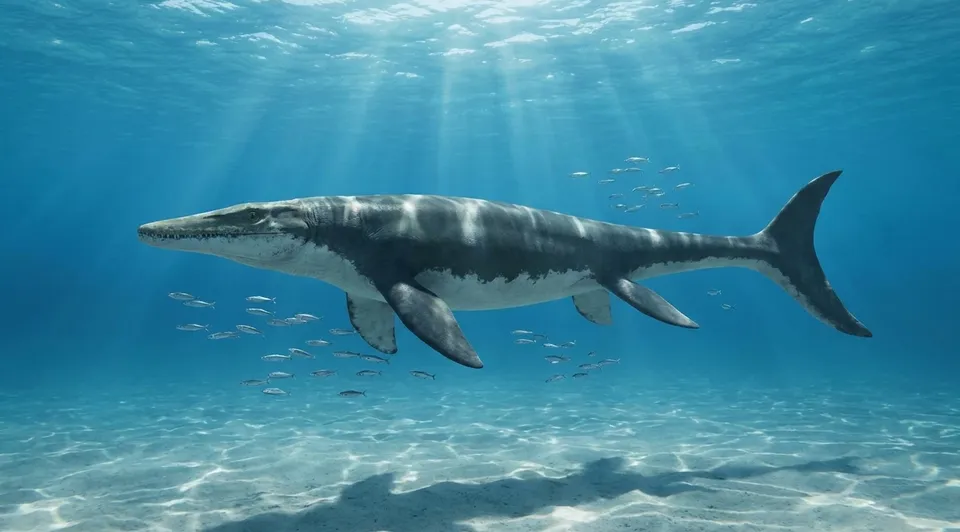
A lizard that went to sea
Tylosaurus was a mosasaur, one of a group of marine reptiles that ruled Late Cretaceous seas. Despite their size, mosasaurs were squamates, the group that includes lizards and snakes; their closest living relatives are often thought to be monitor lizards, although that is debated. They evolved from small lizards that took to the water about 100 million years ago and became top predators in only a few million years.
Tylosaurus was among the biggest of them. Large individuals of the Kansas species, Tylosaurus proriger, reached roughly 9 to 10 metres, and some later species of Tylosaurus may have been larger. Older figures of 13 metres or more came from fossils that were later reassigned and are now doubted. It lived in the Western Interior Seaway, which split North America in two, and its fossils are especially common in the Niobrara Chalk of western Kansas.
Built for ambush
Tylosaurus had a long, narrow head with sharp, cone-shaped teeth, an extra row of teeth on the roof of the mouth to help grip prey, and a jaw that could flex to swallow large items. The front of its snout ended in a long, bony point without teeth, which gave the animal its name; some researchers have suggested it was used to ram prey, but there is no direct evidence.
Exceptionally preserved mosasaur fossils show they had a crescent-shaped tail fin, like that of a shark, and smooth skin with small scales. Some specimens even preserve traces of pigment suggesting a dark back and lighter belly. They swam with powerful strokes of the tail and steered with their flippers.
Young Tylosaurus had much shorter snouts than adults. A 2018 study of a newborn Tylosaurus skull showed that the long bony point grew as the animal matured.
What was in its stomach?
Few prehistoric predators have such a clear menu. Tylosaurus fossils from Kansas have been found with the remains of their last meals inside: fish, sharks, the large flightless seabird Hesperornis, plesiosaurs and even smaller mosasaurs. It was a generalist that ate almost anything it could catch.
Born at sea
Mosasaurs could not crawl onto beaches to lay eggs. Fossils of pregnant mosasaurs with unborn young inside, and tiny newborn mosasaurs found in open-ocean deposits, show that they gave birth to live young at sea, like whales and ichthyosaurs.
The end of the mosasaurs
Mosasaurs reached their greatest diversity at the very end of the Cretaceous, with species around the world, including the giant Mosasaurus. They all disappeared in the mass extinction 66 million years ago, along with the non-bird dinosaurs, plesiosaurs and ammonites.
Measurements are estimates based on fossils and can change as new specimens are found. Illustrations on this page are artist reconstructions, not photographs.
 See it in our documentaryWhat Eats You First? The Sea That Covered Kansas12 min · chapters, the science behind the film and sources
Sources
- Everhart (2017). Oceans of Kansas: A Natural History of the Western Interior Sea. Indiana University Press.
- Lindgren et al. (2010). Convergent evolution in aquatic tetrapods: insights from an exceptional fossil mosasaur. PLoS ONE 5.
- Konishi, Jiménez-Huidobro & Caldwell (2018). The smallest-known neonate individual of Tylosaurus sheds new light on the tylosaurine rostrum and heterochrony. Journal of Vertebrate Paleontology 38.
- Field et al. (2015). Pelagic neonatal fossils support viviparity and precocial life history of Cretaceous mosasaurs. Palaeontology.
- Lindgren et al. (2014). Skin pigmentation provides evidence of convergent melanism in extinct marine reptiles. Nature 506.