The science behind the film
When Kansas was a sea
During the Late Cretaceous, high sea levels flooded the centre of North America, creating the Western Interior Seaway. At its largest it stretched from the Gulf of Mexico to the Arctic Ocean and split the continent into two landmasses, Laramidia in the west and Appalachia in the east. It was warm and relatively shallow, mostly a few hundred metres deep or less.
On its floor, the skeletons of countless microscopic plankton built up into thick layers of chalk. In western Kansas, these rocks are called the Niobrara Chalk, about 87 to 82 million years old. Their soft, white beds have preserved some of the best marine fossils in the world.
Squalicorax, Platecarpus and Clidastes
Squalicorax, the “crow shark”, was a mid-sized shark around two metres long with serrated, curved teeth. Its bite marks and embedded teeth turn up on the bones of mosasaurs, turtles, fish and even a duck-billed dinosaur whose carcass drifted out to sea, which shows it was at least partly a scavenger.
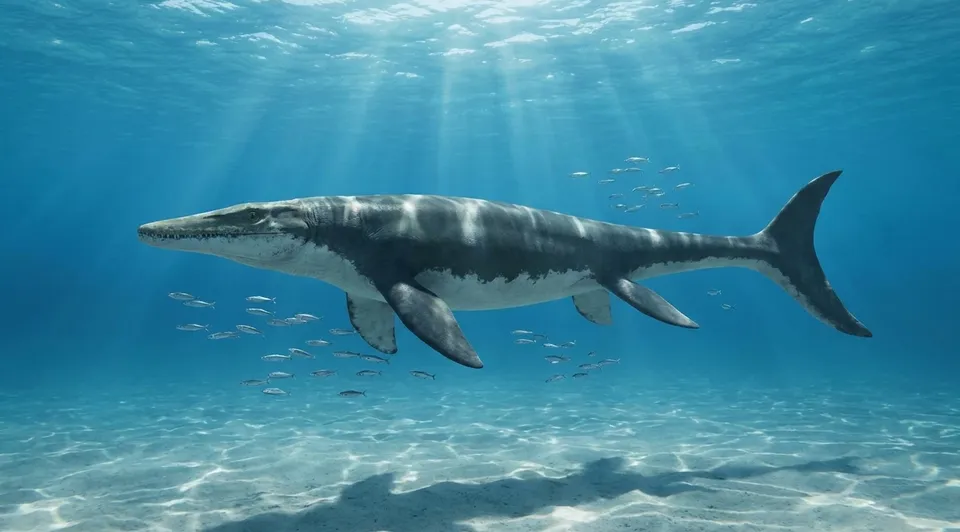
Platecarpus was a mid-sized mosasaur, roughly 5 to 6 metres long. A specimen from Kansas with preserved soft tissue, described in 2010, showed that mosasaurs had a downturned tail and streamlined bodies, and a fossil from Jordan described in 2013 confirmed a shark-like tail fin. Together they changed how artists draw mosasaurs. Clidastes was smaller and slender, built for agility in shallow water.
Xiphactinus, Cretoxyrhina and Tylosaurus
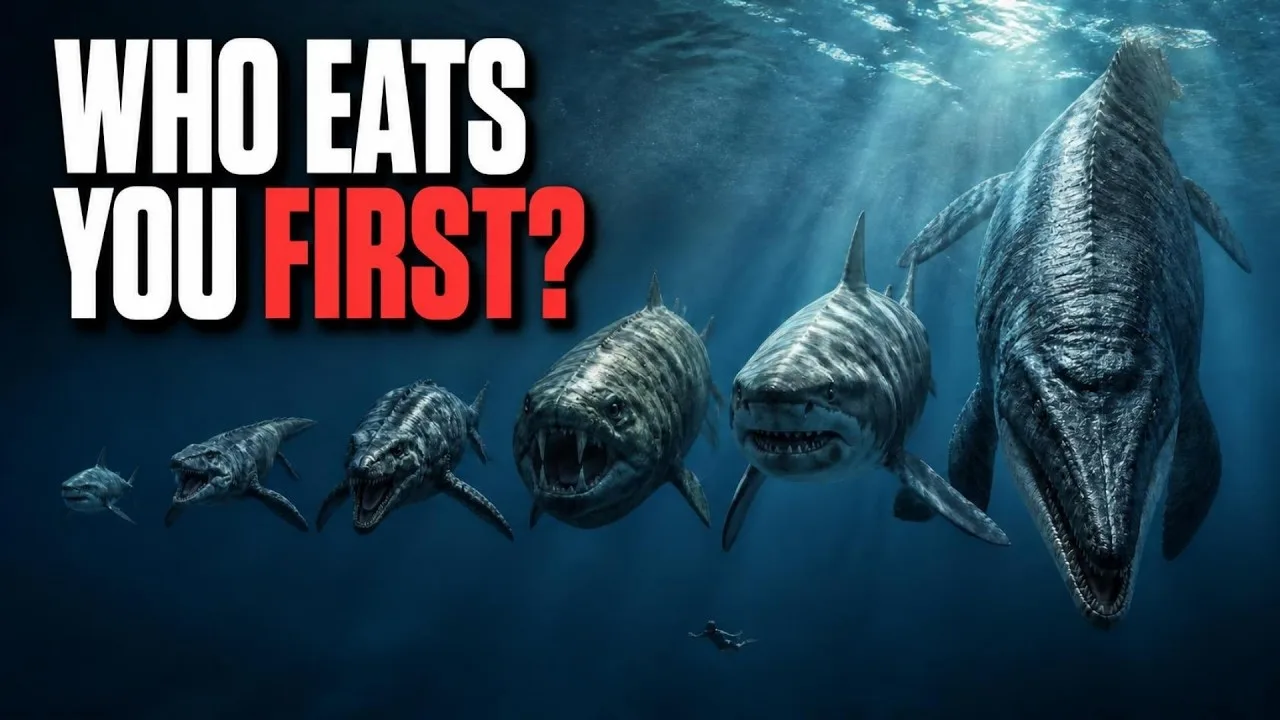
The biggest hunters of the seaway were a fish, a shark and a lizard. Xiphactinus was a bony fish up to about 5 metres long that swallowed prey whole; one famous fossil has a two-metre fish inside it. Cretoxyrhina was a mackerel shark as big as a great white, whose teeth have been found embedded in the bones of other large animals. At the top was Tylosaurus, a mosasaur that reached roughly 9 to 10 metres, whose fossils have been found with sharks, seabirds, plesiosaurs and other mosasaurs in their stomachs.
How do we know what they ate?
Most of what we know about who ate whom in this sea comes from three kinds of evidence: stomach contents preserved inside skeletons, bite marks and broken-off teeth left in bones, and fossilised droppings. The Niobrara Chalk is especially rich in all three because the quiet, low-oxygen seabed preserved carcasses with little disturbance. Fossil hunters such as the Sternberg family collected many of the key specimens from the 1870s onwards.
The film’s scenes are AI-assisted reconstructions based on published evidence. Some behaviour and colours are informed interpretation.
Read the complete guide to the Cretaceous →
Sources
- Everhart (2017). Oceans of Kansas: A Natural History of the Western Interior Sea. 2nd ed. Indiana University Press.
- Everhart. Bite marks on Niobrara vertebrates.
- Lindgren et al. (2010). Convergent evolution in aquatic tetrapods: insights from an exceptional fossil mosasaur. PLoS ONE 5.
- Shimada (1997). Skeletal anatomy of Cretoxyrhina mantelli from the Niobrara Chalk. Journal of Vertebrate Paleontology.
- Sternberg Museum of Natural History, Hays, Kansas.