The skeleton that was lost
The German palaeontologist Ernst Stromer described Spinosaurus in 1915 from bones found in the Bahariya Oasis of Egypt. They included parts of the jaws and vertebrae with spines more than a metre and a half tall. Stromer kept the fossils in the Bavarian State Collection in Munich.
In April 1944 an Allied bombing raid destroyed the museum and the Spinosaurus bones with it. For decades, scientists had only Stromer’s drawings and photographs. Everything we know today comes from fragmentary new finds, mainly from the Kem Kem beds of Morocco, put together with those old records.
A very strange predator
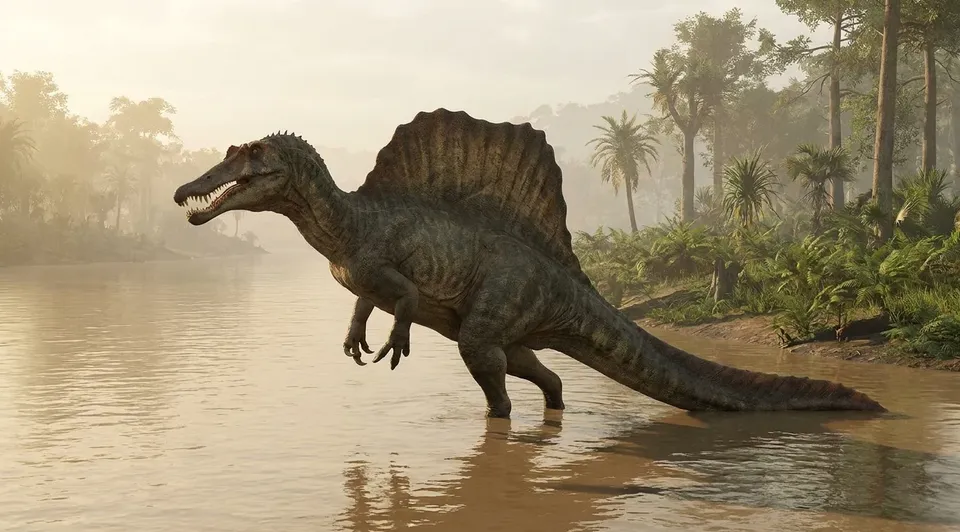
Spinosaurus had a long, low snout like a crocodile’s, with cone-shaped teeth that interlocked when the jaws closed, perfect for gripping slippery fish. The nostrils sat far back on the snout, and small pits at the tip may have held pressure sensors, as in crocodiles.
Along its back ran a tall sail supported by elongated spines. Its length is usually estimated at around 14 metres, which would make it longer than T. rex, although it was probably lighter, with weight estimates of roughly 6 to 7 tonnes. Because the skeleton is so incomplete, these figures are less certain than for most big dinosaurs.
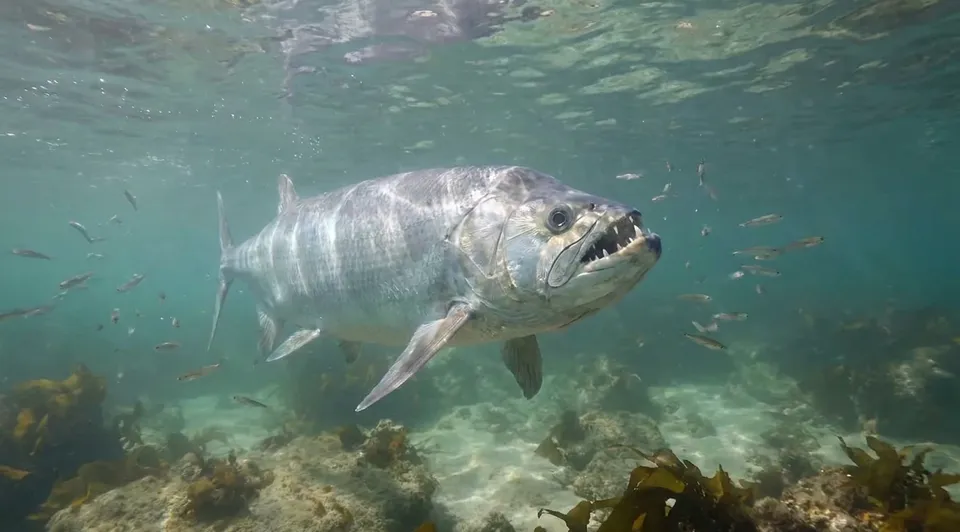
Its fossils come from rivers full of giant fish, such as the sawfish-like Onchopristis and the coelacanth Mawsonia, which were probably its main prey.
Swimmer or heron?
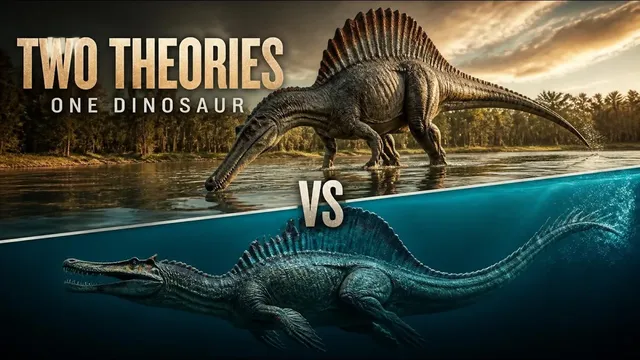
In 2014 a team led by Nizar Ibrahim described a new partial skeleton from Morocco with surprisingly short hind legs. In 2020 the same team showed that the tail had tall, thin spines forming a paddle, and argued that Spinosaurus swam actively after fish. A 2022 study found that its bones were very dense, like those of penguins and hippos, which they interpreted as an adaptation for diving.
Other researchers disagree. Also in 2022, a team led by Paul Sereno built a digital model and found that Spinosaurus would have floated high and unstable in deep water, struggling to dive, and argued it was a wading predator that hunted in shallow water and along shorelines, like a giant heron. Others note that its tail and sail would have made it slow in open water.
Most scientists now agree it spent a lot of time in and around water and ate mostly fish. Whether it chased prey underwater or waded at the edges is the part still argued over.
The 2026 discovery
In February 2026 Sereno’s team described a second species, Spinosaurus mirabilis, in the journal Science. Its fossils come from Jenguebi, in the central Sahara of Niger, in rocks about 95 million years old. It was the first unequivocal new Spinosaurus species named in more than a century.
Its most striking feature is an unusually tall, scimitar-shaped crest on top of the skull, which was probably covered in keratin and used for display. The fossils were found in river deposits hundreds of kilometres from the ancient coast, together with long-necked sauropods. The authors see this as support for a wading, shoreline predator rather than an animal of the open sea. Expect more studies, and more arguments, in the next few years.
Spinosaurus vs T. rex
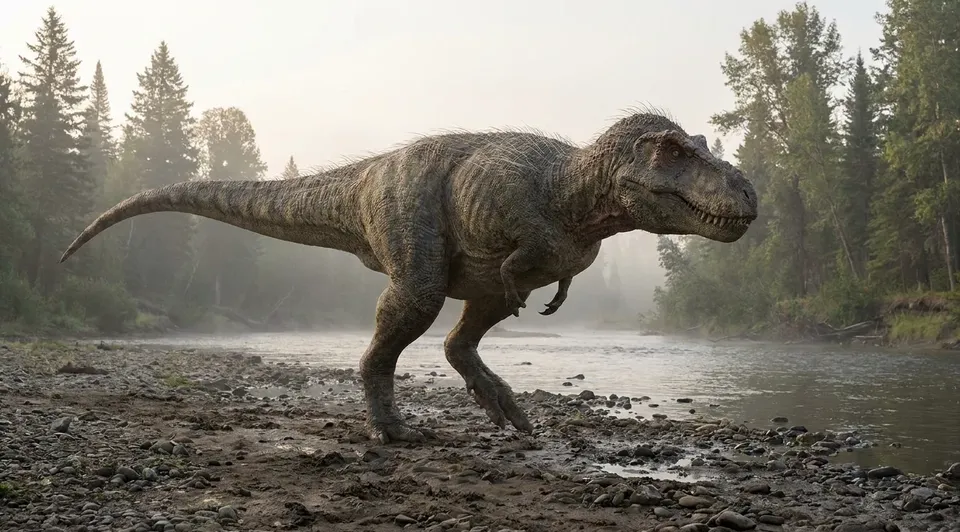
In the film Jurassic Park III, Spinosaurus kills a Tyrannosaurus in a fight. In reality they never met. Spinosaurus lived in North Africa around 95 million years ago; T. rex lived in North America about 30 million years later. Spinosaurus also had a narrow snout built for fish, not for wrestling a giant predator.
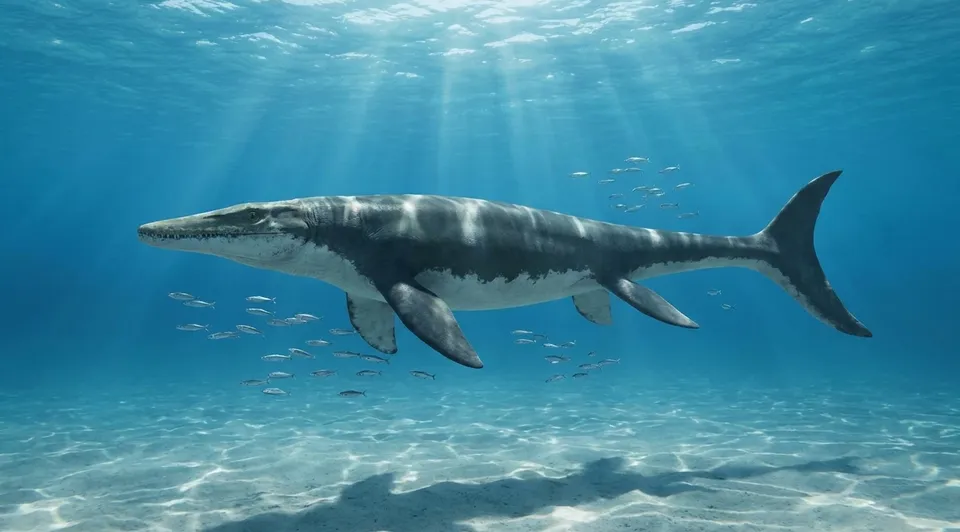
Measurements are estimates based on fossils and can change as new specimens are found. Illustrations on this page are artist reconstructions, not photographs.
 See it in our documentarySpinosaurus: Swimmer or Heron?10 min · chapters, the science behind the film and sources
Sources
- Ibrahim et al. (2014). Semiaquatic adaptations in a giant predatory dinosaur. Science 345.
- Ibrahim et al. (2020). Tail-propelled aquatic locomotion in a theropod dinosaur. Nature 581.
- Fabbri et al. (2022). Subaqueous foraging among carnivorous dinosaurs. Nature 603.
- Sereno et al. (2022). Spinosaurus is not an aquatic dinosaur. eLife 11.
- Hone & Holtz (2021). Evaluating the ecology of Spinosaurus: shoreline generalist or aquatic pursuit specialist? Palaeontologia Electronica.
- Sereno et al. (2026). Scimitar-crested Spinosaurus species from the Sahara caps stepwise spinosaurid radiation. Science 391.