The science behind the film
From Egypt to Munich, and lost
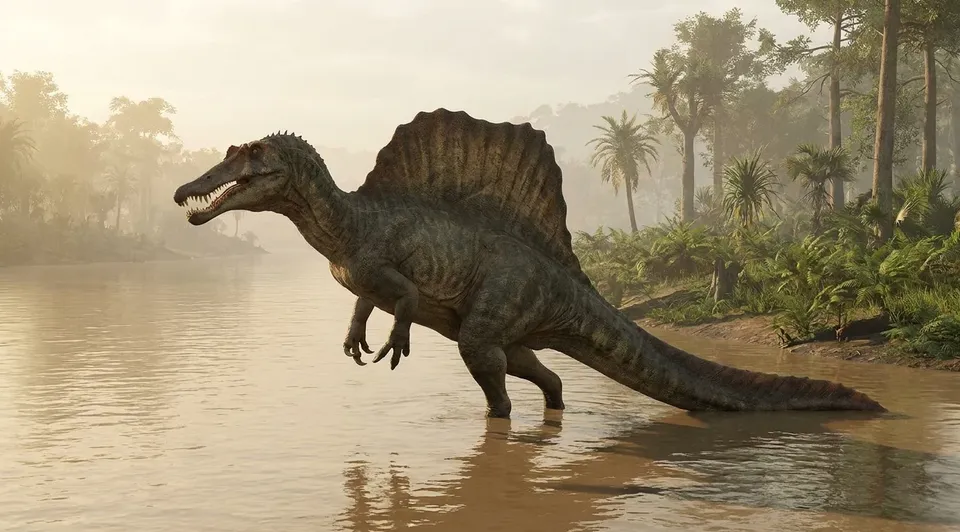
Ernst Stromer described Spinosaurus in 1915 from fossils found in the Bahariya Oasis of Egypt. The bones were stored in Munich, where they were destroyed by an air raid in April 1944. For the next seventy years, everything written about Spinosaurus relied on Stromer’s published drawings and descriptions.
The rebuild
In 2014 a team led by Nizar Ibrahim described a partial skeleton from the Kem Kem beds of Morocco and made it the new reference specimen. Combined with other fragments and Stromer’s records, it produced a surprising animal: short hind legs, a long neck and trunk, dense bones and a long, low skull. In 2020 the team added the tail, which was tall and flexible like a paddle.
The two theories
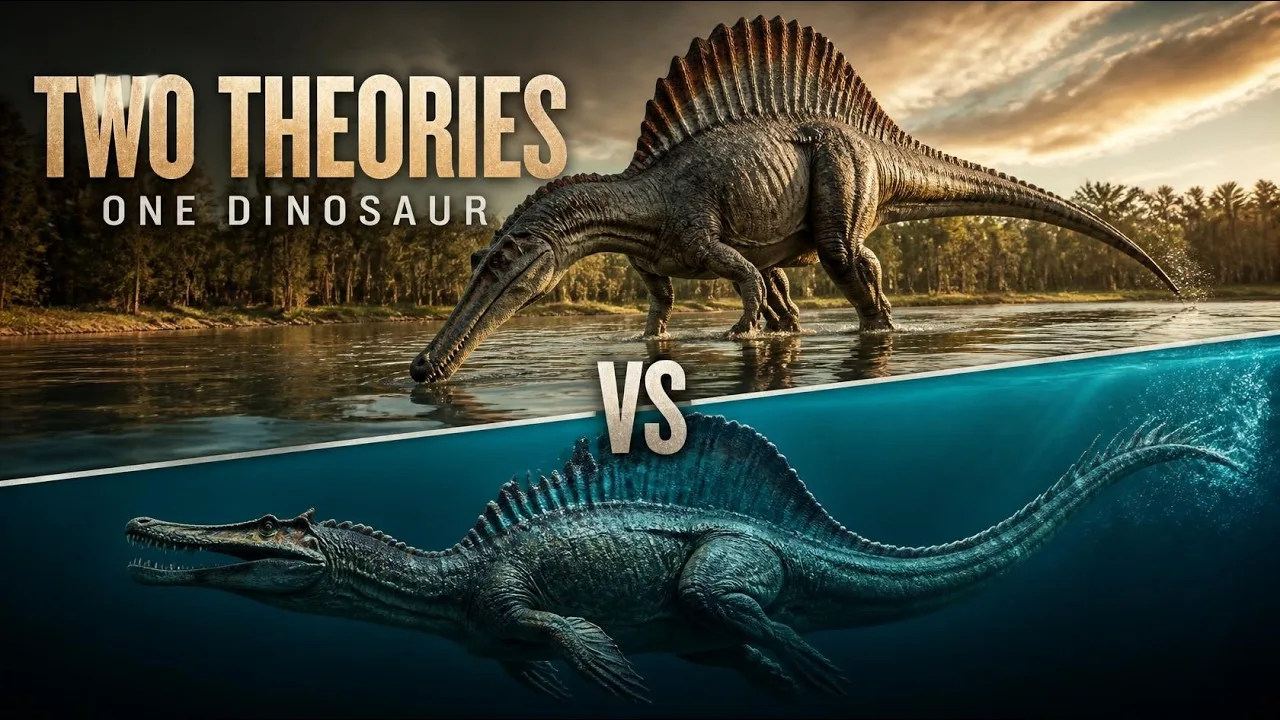
One side argues that Spinosaurus was a semi-aquatic pursuit predator that swam after fish using its tail. Its dense bones, paddle-like tail and nostrils set back on the snout are seen as adaptations for life in water.
The other side argues that it was a wading predator that hunted from the shallows, like a heron or stork. Computer models by Paul Sereno’s team found it would have floated high and been unstable in deep water, and others noted that its large sail would have created drag. Many researchers now favour a middle position: an animal closely tied to water that spent much of its time wading, and could probably swim, but was not a fast underwater hunter.
The 2026 discovery
In February 2026, Sereno and colleagues described Spinosaurus mirabilis in the journal Science, the first unequivocal new Spinosaurus species named in more than a century. It comes from the Farak Formation of Niger, about 95 million years old, and had a tall, scimitar-shaped crest on its head. It was found in river deposits far inland, together with long-necked sauropods, which the authors see as support for a wading lifestyle. Supporters of the swimming hypothesis are likely to reply, so this debate is far from over.
The film’s scenes are AI-assisted reconstructions based on published evidence. Some behaviour and colours are informed interpretation.
Read the full Spinosaurus profile →
Sources
- Ibrahim et al. (2014). Semiaquatic adaptations in a giant predatory dinosaur. Science 345.
- Ibrahim et al. (2020). Tail-propelled aquatic locomotion in a theropod dinosaur. Nature 581.
- Fabbri et al. (2022). Subaqueous foraging among carnivorous dinosaurs. Nature 603.
- Sereno et al. (2022). Spinosaurus is not an aquatic dinosaur. eLife 11.
- Sereno et al. (2026). Scimitar-crested Spinosaurus species from the Sahara caps stepwise spinosaurid radiation. Science 391.