The king is found
The fossil collector Barnum Brown found the first partial skeleton in 1902 in the Hell Creek Formation of Montana, working for the American Museum of Natural History. In 1905 the museum’s president, Henry Fairfield Osborn, named it Tyrannosaurus rex, the “tyrant lizard king”.
Since then dozens of specimens have been found, several of them famous in their own right. “Sue”, at the Field Museum in Chicago, is one of the largest and most complete. “Scotty”, from Saskatchewan in Canada, is thought to be one of the heaviest. T. rex lived between about 68 and 66 million years ago on Laramidia, the western landmass of North America, which was then separated from the east by a shallow inland sea.
How big was it?
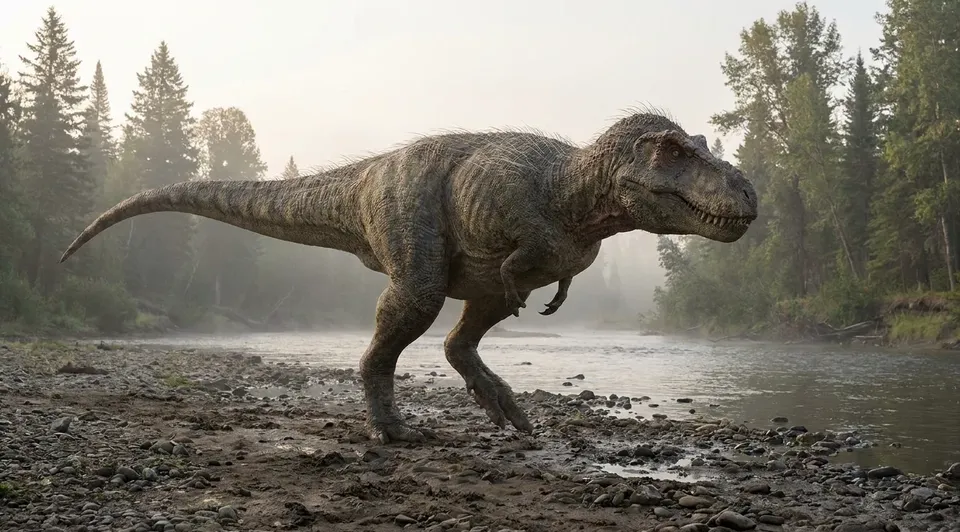
Adult T. rex reached about 12 metres in length, and Sue measures roughly 12.3 metres. Weight is harder: most modern estimates for big adults fall between about 8 and 9 tonnes, though different methods give answers from around 6 to more than 10 tonnes.
Its skull was up to about 1.5 metres long, deep and heavily built, with banana-sized teeth. The arms were only about a metre long with two working fingers, but they were muscular. What they were used for is still debated: holding prey, helping the animal get up from the ground, or simply shrinking because the head did all the work.
Skin impressions from several parts of the body show small scales. Its early relatives, such as Yutyrannus from China, had feathers, so T. rex may have had some filaments, but there is no direct evidence for a feathery coat on adults.
A bite that crushed bone
T. rex had one of the most powerful bites of any land animal known. A 2012 computer study estimated a bite force of tens of thousands of newtons at the back teeth, several times stronger than a lion or an alligator. Its teeth were thick and rounded in cross-section, built to punch through bone rather than slice flesh.
The evidence is in the fossils. A huge fossil dropping from Saskatchewan, almost certainly from a tyrannosaur, is packed with fragments of crushed bone from a young plant-eater. Bones of Triceratops and Edmontosaurus carry deep tooth punctures and scrape marks that match T. rex teeth.
Growing up fast
Growth rings in T. rex bones work like tree rings. They show that it grew slowly as a small juvenile, then went through a teenage growth spurt in which it could add more than 700 kilograms a year, reaching adult size at around 20 years old. Sue was probably about 30 years old when it died, which is old for a T. rex.
Young tyrannosaurs were slim, long-legged and fast, very different from the bulky adults, so juveniles and adults probably hunted different prey. Some scientists think this is why there were few medium-sized predators in its world: young T. rex filled that role themselves.
That idea has been complicated by the long debate over Nanotyrannus, a small tyrannosaur from the same rocks. For decades many researchers treated it as a juvenile T. rex, but in 2025 a study of the famous “Dueling Dinosaurs” fossil argued that it was a separate, distinct animal. The debate is not fully settled.
Hunter or scavenger?
One old argument held that T. rex was only a scavenger, too slow and clumsy to hunt. Most palaeontologists today see it as both, like lions and hyenas, which hunt and scavenge depending on the opportunity.
A key piece of evidence is a tail bone of the duck-billed dinosaur Edmontosaurus with a T. rex tooth embedded in it and healed bone grown around it. The plant-eater was attacked while alive and escaped. T. rex also had forward-facing eyes with good depth perception and large areas of the brain devoted to smell, the toolkit of an active predator.
In 2024 a tyrannosaur from New Mexico, slightly older than T. rex, was named as a new species, Tyrannosaurus mcraeensis. Other researchers argue the fossils are too incomplete to separate it from T. rex, so its status is still debated.
The last of its kind
T. rex lived until the very end of the Cretaceous. Its fossils occur in the last metres of rock below the layer that marks the asteroid impact 66 million years ago. It was there, with Triceratops and Edmontosaurus, when the world changed in a single day, and it did not survive.
Its closest living relatives are birds, which descend from small feathered theropods related to the tyrannosaurs.
Measurements are estimates based on fossils and can change as new specimens are found. Illustrations on this page are artist reconstructions, not photographs.
 See it in our documentaryCould a T. rex Survive Every Era?10 min · chapters, the science behind the film and sources
Sources
- Osborn (1905). Tyrannosaurus and other Cretaceous carnivorous dinosaurs. Bulletin of the AMNH 21.
- Erickson et al. (2004). Gigantism and comparative life-history parameters of tyrannosaurid dinosaurs. Nature 430.
- Bates & Falkingham (2012). Estimating maximum bite performance in Tyrannosaurus rex. Biology Letters.
- Chin et al. (1998). A king-sized theropod coprolite. Nature 393.
- DePalma et al. (2013). Physical evidence of predatory behavior in Tyrannosaurus rex. PNAS 110.
- Bell et al. (2017). Tyrannosauroid integument reveals conflicting patterns of gigantism and feather evolution. Biology Letters.
- Zanno & Napoli (2025). Nanotyrannus and Tyrannosaurus coexisted at the close of the Cretaceous. Nature.
- Field Museum. SUE the T. rex.