The science behind the film
Jump 1: the Ice Age
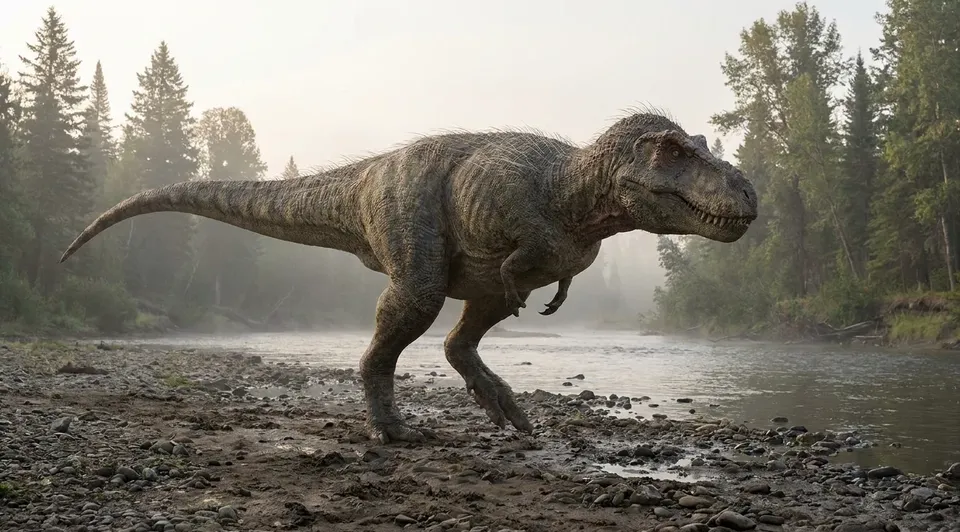
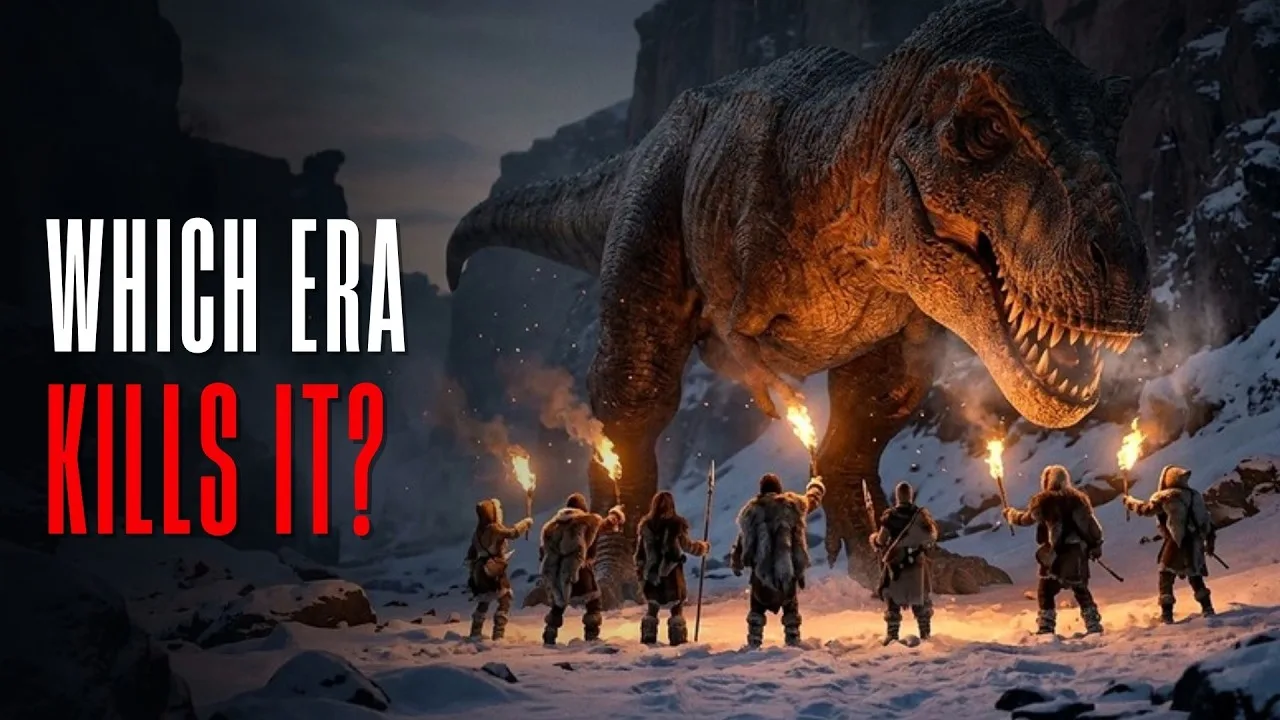
Around 20,000 years ago, much of North America was covered by ice sheets up to several kilometres thick, and the land south of them was cold, dry steppe and open woodland. The animals were mammals adapted to cold: woolly and Columbian mammoths, bison, horses, sabre-toothed cats, dire wolves and short-faced bears, together with groups of human hunters. A T. rex would have been the largest predator there, but it evolved in a warm world, and long, cold winters would have been a serious problem for an animal its size with little or no insulation.
Jump 2: the age of Titanoboa
About 60 million years ago, a few million years after the dinosaurs disappeared, South America was covered in hot, wet rainforest. In what is now the Cerrejón coal mine in Colombia, scientists found vertebrae of Titanoboa, a snake estimated at around 13 metres long and more than a tonne, the largest snake known. Its size suggests the tropics were even hotter than today. Crocodile relatives and giant turtles shared its swamps.
Jump 3: the river of giants
Around 95 million years ago, the rivers of North Africa supported an unusual number of large predators: Spinosaurus, the fish-eating, sail-backed giant, and Carcharodontosaurus, a meat-eater as long as T. rex with blade-like teeth. These fossils come from the Kem Kem beds of Morocco and Algeria. How so many big predators coexisted is still debated; part of the answer is probably that they ate different prey, with Spinosaurus specialising in fish.
Jumps 4 and 5: Jurassic and Triassic
In the Late Jurassic, about 150 million years ago, the top predator of North America was Allosaurus, smaller and lighter than T. rex. Further back, in the Late Triassic around 210 million years ago, dinosaurs were mostly small, and the large land predators included rauisuchians such as Postosuchus, crocodile relatives about 4 to 5 metres long. A T. rex would have dwarfed all of them.
Jump 6: before the dinosaurs
About 255 million years ago, at the end of the Permian, the top predators were gorgonopsians, sabre-toothed relatives of mammals. Inostrancevia, known from Russia and later also from South Africa, reached around 3.5 metres long with canines over 10 centimetres. The Permian ended with the largest mass extinction in Earth’s history.
Jump 7: giant bugs and fire
Around 300 million years ago, in the Carboniferous and early Permian, atmospheric oxygen was much higher than today, perhaps around 30 percent compared with about 21 percent now. High oxygen is linked to giant arthropods such as the griffinfly Meganeura, with a wingspan of around 70 centimetres, and the millipede-like Arthropleura, up to about 2.6 metres long. It also made wildfires more frequent, as shown by abundant fossil charcoal in rocks of that age.
Jump 8: a world without oxygen
Two and a half billion years ago, Earth’s atmosphere had almost no free oxygen. Life consisted of microbes, and the only visible signs of it were mats and mounds of bacteria called stromatolites. Oxygen began to build up during the Great Oxidation Event, which started around 2.4 billion years ago, thanks to photosynthesising cyanobacteria. A T. rex dropped into that world would suffocate within minutes: no predator needed.
The film’s scenes are AI-assisted reconstructions based on published evidence. Some behaviour and colours are informed interpretation.
Read the full Tyrannosaurus rex profile →
Sources
- Head et al. (2009). Giant boid snake from the Palaeocene neotropics reveals hotter past equatorial temperatures. Nature 457.
- Ibrahim et al. (2020). Geology and paleontology of the Upper Cretaceous Kem Kem Group of eastern Morocco. ZooKeys 928.
- Berner (2006). GEOCARBSULF: a combined model for Phanerozoic atmospheric O2 and CO2. Geochimica et Cosmochimica Acta 70.
- Lyons, Reinhard & Planavsky (2014). The rise of oxygen in Earth’s early ocean and atmosphere. Nature 506.
- Kammerer et al. (2023). Inostrancevia in the Karoo Basin of South Africa. Current Biology.