When is the Quaternary?
The Quaternary Period began 2.58 million years ago and continues today. It is the most recent period of the Cenozoic Era, the “age of mammals” that followed the extinction of the dinosaurs. It is divided into two epochs: the Pleistocene, from 2.58 million to 11,700 years ago, and the Holocene, from 11,700 years ago to the present.
When people talk about “the Ice Age”, they usually mean the Pleistocene, and especially its last glacial period, which ended about 11,700 years ago. Strictly speaking, Earth is still in an ice age today, because large ice sheets still cover Greenland and Antarctica; we live in a warmer phase within it.
Its two epochs
Geologists split the Quaternary into parts called epochs. Tap through them below.
The Ice Age. Dozens of cycles in which ice sheets grew and melted. Mammoths, woolly rhinos, giant sloths and sabre-toothed cats roamed; Homo sapiens evolved in Africa and spread worldwide.
The warm interval since the last glacial period ended about 11,700 years ago. Farming, cities and written history all belong to the Holocene.
Glacial cycles: ice comes and goes
The Quaternary was not one long freeze. The climate swung back and forth dozens of times between cold glacial periods, when ice sheets spread across North America and northern Europe, and warmer interglacials like today. These cycles are linked to small, regular changes in Earth’s orbit and tilt, called Milankovitch cycles, amplified by changes in greenhouse gases and ice cover. For the last million years or so, each cycle has lasted roughly 100,000 years.
At the peak of the last glacial period, around 26,000 to 20,000 years ago, the Laurentide ice sheet covered most of Canada and parts of the northern United States, and sea level was about 120 metres lower than today. Land bridges appeared, such as Beringia between Siberia and Alaska, which allowed animals and people to cross between continents.
Landscapes: the mammoth steppe
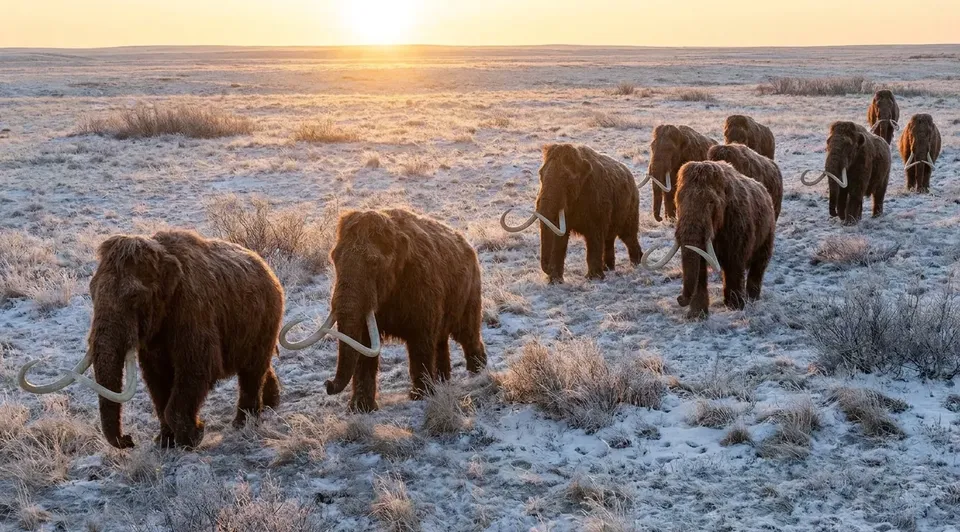
During glacial periods, a vast cold, dry grassland covered much of northern Eurasia and Beringia. Scientists call it the mammoth steppe. Unlike today’s wet tundra, it was rich in grasses and herbs and supported huge herds of grazing animals. Further south lay open woodlands, forests and grasslands. Modern flowering plants, grasses and trees dominated, much as they do today.
Animals of the Quaternary
The Pleistocene is famous for its megafauna, the giant mammals that lived alongside early humans on every continent except Antarctica. Many survived until just a few thousand years ago.
A cold-adapted elephant of the northern steppes, known from frozen carcasses. Survived on Wrangel Island until about 4,000 years ago.
Read the full profileA shaggy rhino of Ice Age Eurasia with a long, flattened front horn, painted on cave walls by early humans.
An elephant-sized sloth from South America that could rear up on its hind legs to feed. Relatives lived across the Americas.
A car-sized relative of armadillos covered in a domed shell of bony plates.
The sabre-toothed cat, with upper canines up to about 18 cm. Thousands were trapped at La Brea.
Read the full profileHomotheriumHomotherium latidensA long-legged scimitar-toothed cat. A Texas cave holds its remains with hundreds of young mammoth teeth.
Read the full profileA heavy wolf-like canid from a lineage that split from grey wolves millions of years ago.
A long-legged giant bear of North America, possibly up to around 900 kg.
Read the full profileA large lion of Ice Age Eurasia, painted in the Chauvet Cave in France.
Our species evolved in Africa around 300,000 years ago and spread across the world during the late Pleistocene.
Ice Age humans of Europe and western Asia who disappeared about 40,000 years ago. Many people today carry a little Neanderthal DNA.
An early human species that spread out of Africa across Asia and survived for well over a million years.
Animals with a “Read the full profile” link have their own illustrated article. More are added with each new documentary.
Where its fossils are found
- La Brea Tar Pits, Los Angeles, USA. Natural asphalt seeps that trapped Ice Age animals, with millions of fossils including thousands of dire wolves and sabre-toothed cats.
- White Sands, New Mexico, USA. Fossil footprints of people, mammoths and ground sloths, some dated to about 23,000–21,000 years ago.
- Siberian and Yukon permafrost. Frozen carcasses of mammoths, woolly rhinos, cave lion cubs and a sabre-toothed kitten, some with skin and fur.
- Chauvet and Lascaux, France. Caves with paintings of mammoths, woolly rhinos, lions and horses made by Ice Age people.
- Wrangel Island, Russia. The last refuge of the woolly mammoth, until about 4,000 years ago.
How the Quaternary ended
Unlike the other periods on this site, the Quaternary has not ended. But the Pleistocene ended about 11,700 years ago, when the last glacial period gave way to the warmer Holocene.
Around this time, most of the world’s largest land mammals vanished. Australia lost its giant animals earlier, around 45,000 years ago; northern Eurasia and the Americas lost mammoths, ground sloths, sabre-toothed cats and many others between about 15,000 and 10,000 years ago. Scientists still debate how much was caused by climate change and how much by human hunting, and many think both mattered.
Geologists also debated adding a new epoch, the Anthropocene, to mark human impact on the planet. In 2024 the international body responsible voted against making it an official epoch, although the term is still widely used informally.
Key points for your test
- The Quaternary began 2.58 million years ago and continues today.
- It has two epochs: the Pleistocene (the Ice Age) and the Holocene, which began 11,700 years ago.
- The climate swung between glacial and interglacial periods, linked to changes in Earth’s orbit.
- Low sea levels created land bridges like Beringia, which let animals and people reach the Americas.
- Famous animals: woolly mammoths, woolly rhinos, sabre-toothed cats, dire wolves and giant ground sloths.
- Homo sapiens spread across the world; most megafauna went extinct at the end of the Pleistocene.
Sources
- International Commission on Stratigraphy. International Chronostratigraphic Chart.
- Encyclopaedia Britannica. Quaternary.
- Clark et al. (2009). The Last Glacial Maximum. Science 325.
- Hays, Imbrie & Shackleton (1976). Variations in the Earth’s orbit: pacemaker of the ice ages. Science 194.
- Koch & Barnosky (2006). Late Quaternary extinctions: state of the debate. Annual Review of Ecology, Evolution, and Systematics 37.
- Bennett et al. (2021). Evidence of humans in North America during the Last Glacial Maximum. Science 373.