A different kind of sabre-tooth
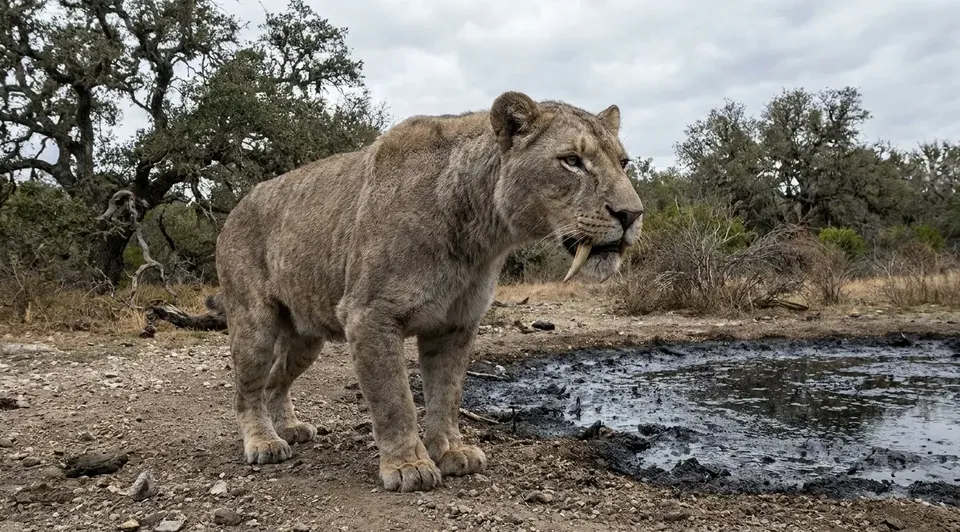
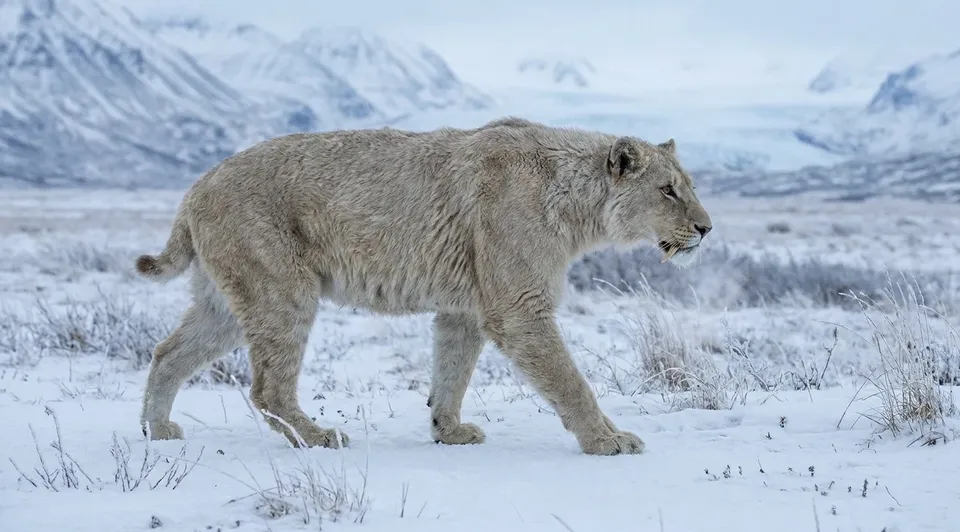
Most researchers now place the North American Homotherium serum in the same species as the Eurasian H. latidens, the name used here. Homotherium was another machairodont, a relative of Smilodon, but with a very different body. It had long front legs, a sloping back like a hyena’s and shorter, flattened, serrated canines shaped like scimitars. Its build suggests a predator that could travel long distances and run at moderate speed, rather than an ambush hunter.
The genus was extraordinarily widespread, with fossils from North America, South America, Europe, Asia and Africa, and it survived for millions of years.
The cave of mammoth calves
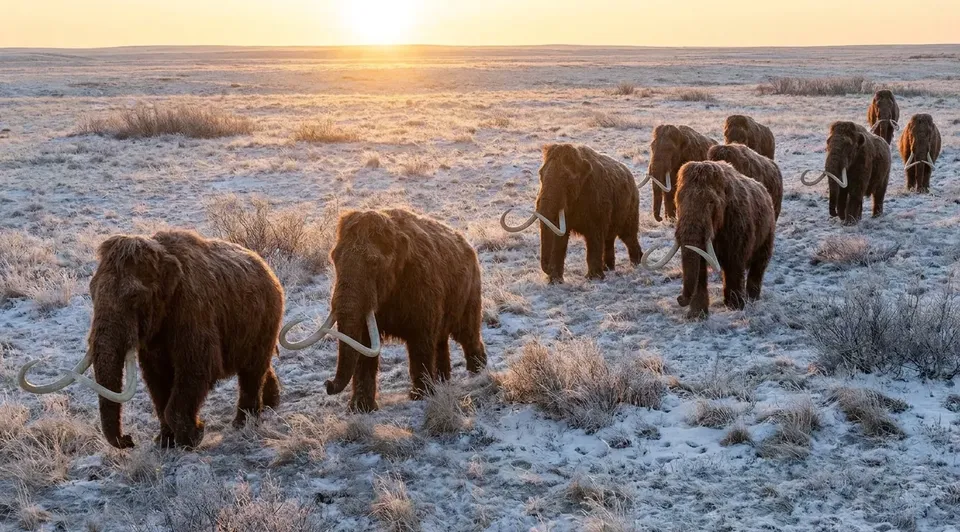
Friesenhahn Cave in Texas contains the remains of many Homotherium, adults and cubs, together with hundreds of teeth from young Columbian mammoths. Most of the mammoth remains come from calves and juveniles, and many bones carry marks consistent with large cat teeth.
The likely explanation is that Homotherium hunted young mammoths and dragged parts of their bodies back to the cave, perhaps a den, to feed. It is one of the clearest records of what a specific Ice Age predator ate.
A frozen cub
In 2024 scientists described the mummified body of a three-week-old Homotherium cub, about 35,000 years old, found in permafrost in Yakutia, Siberia. It was the first time anyone had seen what this animal looked like in life: thick dark fur, a broad muzzle, small ears and wide paws suited to walking on snow.
Earlier, a 2020 study of Homotherium DNA found genes linked to daytime vision, endurance and complex social behaviour, supporting the idea that it hunted in groups in open landscapes.
Disappearance
Homotherium survived in some regions until late in the last Ice Age. Like many big predators, it disappeared as the large prey animals it depended on declined.
Measurements are estimates based on fossils and can change as new specimens are found. Illustrations on this page are artist reconstructions, not photographs.
 See it in our documentaryWe Are Here Thanks to Them: the Ice Age8 min · chapters, the science behind the film and sources
Sources
- Marean & Ehrhardt (1995). Paleoanthropological and paleoecological implications of the taphonomy of a sabertooth’s den. Journal of Human Evolution 29.
- Barnett et al. (2020). Genomic adaptations and evolutionary history of the extinct scimitar-toothed cat, Homotherium latidens. Current Biology 30.
- Lopatin et al. (2024). Mummy of a juvenile sabre-toothed cat Homotherium latidens from the Upper Pleistocene of Siberia. Scientific Reports 14.