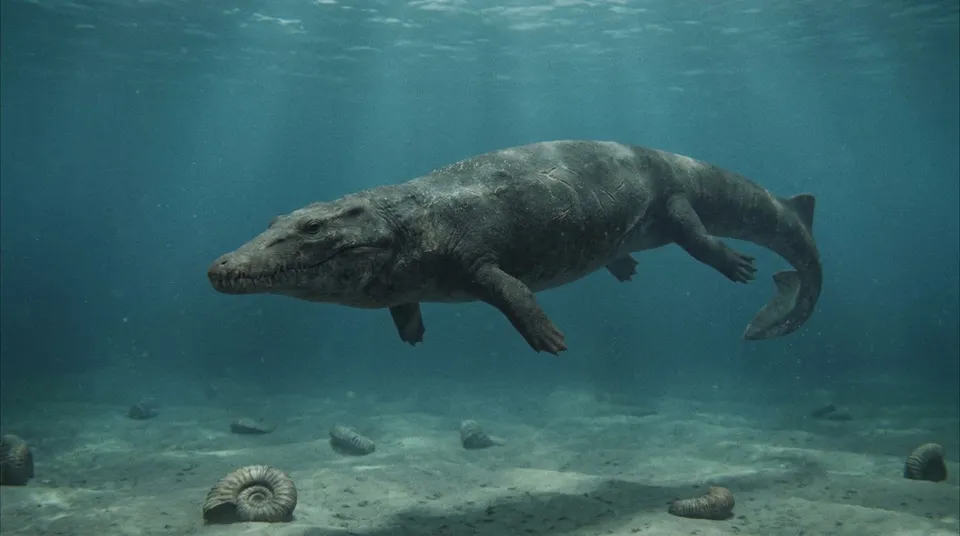
A sea crocodile
Dakosaurus was a metriorhynchid, a member of an extinct family of crocodile relatives that left the land for the open sea. They lost the bony armour of crocodiles, their legs became paddles, and their tail ended in a downturned fin like a shark’s.
The German palaeontologist Friedrich August Quenstedt named it in 1856 from unusually large teeth. Later skeletons showed it was about 4.5 metres long, similar in size to other sea crocodiles.
Short snout, big teeth
Most sea crocodiles had long, narrow snouts for catching fish. Dakosaurus had a short, deep skull with large serrated teeth that fitted tightly together, a design suited to cutting chunks from large prey. Researchers think it could tackle animals close to its own size. One British tooth found off Chesil Beach in Dorset is about 5.5 centimetres long.
It was a powerful predator, but not the top one. It shared the seas with much larger pliosaurs.
From German teeth to an Argentine “Godzilla”
The German naturalist Friedrich August Quenstedt named Dakosaurus in 1856, based on large, serrated teeth from southern Germany. For a long time those teeth and some fragments from England and elsewhere were almost all that was known.
That changed in 2005, when a well-preserved skull from the Vaca Muerta Formation in Argentina was described as a new species, Dakosaurus andiniensis. The skull was short and deep, unlike the slim snouts of most sea crocodiles, and the press nicknamed the animal “Godzilla”. The largest Dakosaurus were probably around four to five metres long.
A crocodile that never came ashore
Metriorhynchids were fully adapted to life in the sea. Skull studies of their close relative Metriorhynchus found evidence of large salt glands, like those of sea turtles and marine birds, which let them drink seawater and get rid of the extra salt.
Their limbs were too weak to move on land, so researchers think they probably gave birth in the water rather than laying eggs on beaches, as crocodiles do today, although direct fossil proof of this has not been found. In Late Jurassic seas Dakosaurus shared its world with ichthyosaurs, plesiosaurs and pliosaurs, and its cutting teeth suggest it competed with them for big prey.
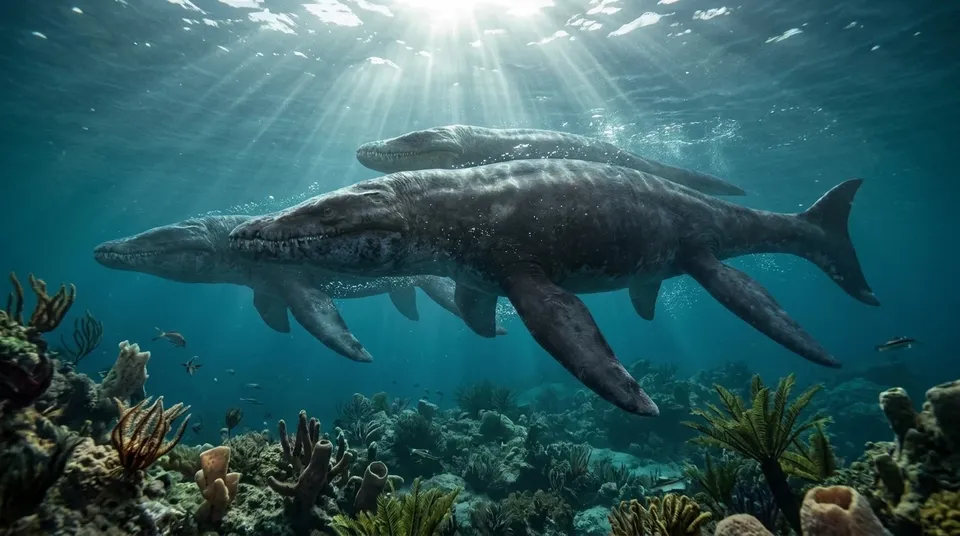
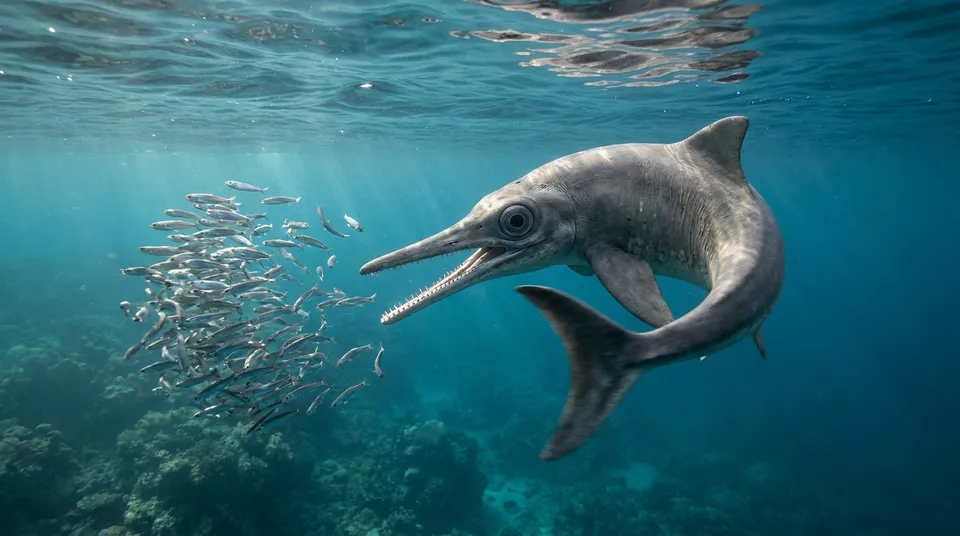
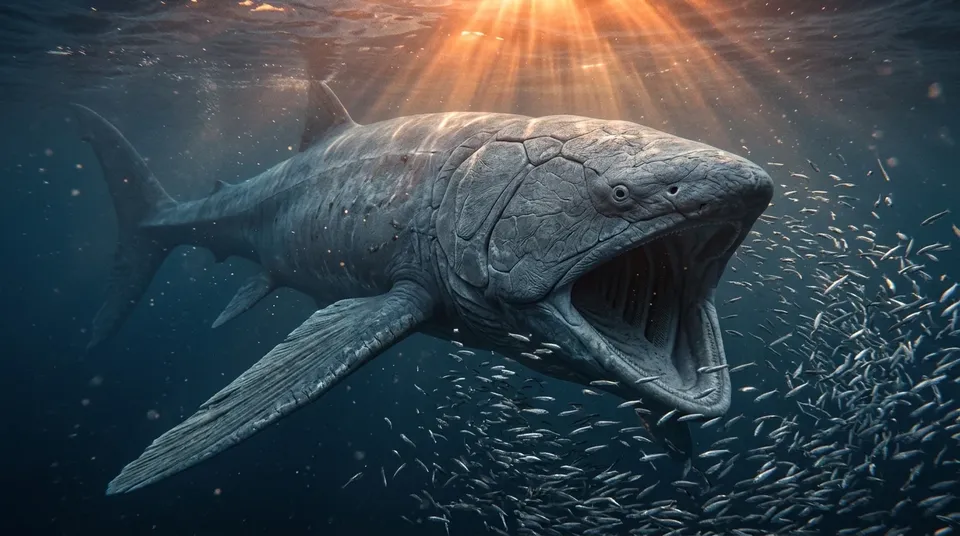
Measurements are estimates based on fossils and can change as new specimens are found. Illustrations on this page are artist reconstructions, not photographs.
 See it in our documentaryA Day in the Jurassic21 min · chapters, the science behind the film and sources
Sources
- Young et al. (2012). The cranial osteology and feeding ecology of the metriorhynchid crocodylomorph genera Dakosaurus and Plesiosuchus from the Late Jurassic of Europe. PLOS ONE 7(9): e44985.
- Young et al. (2014). Largest known specimen of the genus Dakosaurus from the Kimmeridge Clay Formation of England.