Earth is about 4.57 billion years old. To make sense of that enormous span, geologists divide it into named units, from the largest to the smallest: eons, eras, periods, epochs and ages. The boundaries are usually set where the rocks show a big change in life or environment, often a mass extinction.
The big picture
- Precambrian (about 4,567 to 538.8 million years ago): almost 90% of Earth’s history. The planet forms, oceans appear and life begins as microbes. Complex animals only appear right at the end. “Precambrian” is an informal name covering the Hadean, Archean and Proterozoic eons.
- Phanerozoic eon (538.8 million years ago to today): the eon of visible animal life, divided into three eras:
- Paleozoic (“ancient life”): seas full of trilobites and fish, then the first forests and land animals. Ends with the Permian mass extinction.
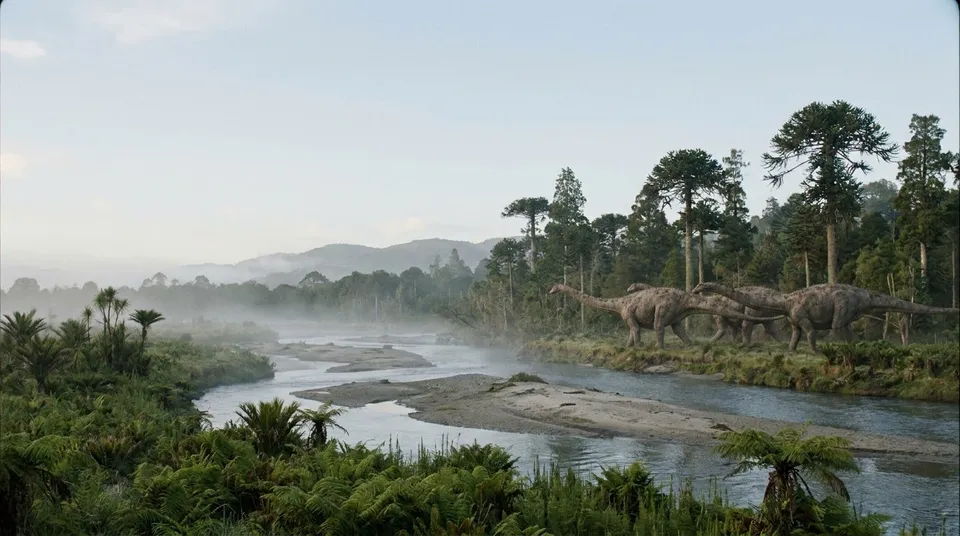
- Mesozoic (“middle life”): the Age of Dinosaurs. Ends with the asteroid impact 66 million years ago.
- Cenozoic (“new life”): the age of mammals, including the Ice Ages and the appearance of humans.
All the periods, with dates
| Era | Period | Million years ago |
|---|---|---|
| Cenozoic | Quaternary | 2.58 – 0 |
| Cenozoic | Neogene | 23.03 – 2.58 |
| Cenozoic | Paleogene | 66 – 23.03 |
| Mesozoic | Cretaceous | 145 – 66 |
| Mesozoic | Jurassic | 201.4 – 145 |
| Mesozoic | Triassic | 251.9 – 201.4 |
| Paleozoic | Permian | 298.9 – 251.9 |
| Paleozoic | Carboniferous | 358.9 – 298.9 |
| Paleozoic | Devonian | 419.2 – 358.9 |
| Paleozoic | Silurian | 443.8 – 419.2 |
| Paleozoic | Ordovician | 485.4 – 443.8 |
| Paleozoic | Cambrian | 538.8 – 485.4 |
| Precambrian | Precambrian | 4567 – 538.8 |
Dates follow the International Chronostratigraphic Chart. Some boundaries are known very precisely, others less so, and they are occasionally refined.
A trick to remember the periods
From oldest to youngest, the periods of the Phanerozoic are Cambrian, Ordovician, Silurian, Devonian, Carboniferous, Permian, Triassic, Jurassic, Cretaceous, Paleogene, Neogene and Quaternary. A classic sentence uses their first letters: “Camels Often Sit Down Carefully. Perhaps Their Joints Creak. Probably Not Quietly.”
How do we know the dates?
The order of rock layers shows which came first: younger layers lie on top of older ones. Fossils help match layers of the same age in different places. Exact ages in millions of years come from radiometric dating: some elements in volcanic rocks, such as uranium, decay into other elements at a known, steady rate, so measuring how much has decayed tells us how long ago the rock formed.
Key points for your test
- Earth is about 4.6 billion years old.
- Units from largest to smallest: eon → era → period → epoch → age.
- The three eras of the Phanerozoic are the Paleozoic, Mesozoic and Cenozoic.
- The Mesozoic contains the Triassic, Jurassic and Cretaceous, the Age of Dinosaurs.
- Era boundaries are marked by mass extinctions (end-Permian, 251.9 Ma; end-Cretaceous, 66 Ma).
- Ages are measured by radiometric dating; the order of layers is given by stratigraphy.