When was the Triassic?
The Triassic Period began about 251.9 million years ago and ended about 201.4 million years ago, lasting roughly 50 million years. It is the first of the three periods of the Mesozoic Era, followed by the Jurassic and the Cretaceous.
The German geologist Friedrich von Alberti named it in 1834. In central Germany the rocks of this age form three distinct layers, a red sandstone, a shelly limestone and a set of colourful mudstones, and the name simply means “threefold”.
The Triassic began straight after the end-Permian mass extinction, often called the Great Dying, when around 80 to 90 percent of marine species and a large share of land animals disappeared. Everything that happened in the Triassic was, in a sense, a recovery from that catastrophe.
Its three epochs
Geologists split the Triassic into parts called epochs. Tap through them below.
A slow recovery after the worst extinction in Earth’s history. Hot, harsh conditions; the plant-eating mammal relative Lystrosaurus is found across much of Pangaea.
Ecosystems rebuild. Archosaurs, the group that includes crocodile and dinosaur ancestors, spread on land, while nothosaurs, placodonts and ichthyosaurs fill shallow seas.
The first dinosaurs, the first pterosaurs, the first turtles and the first mammal-like mammaliaforms all appear. Crocodile relatives still rule the land.
What the world looked like
Almost all the land on Earth was joined in one supercontinent, Pangaea, shaped roughly like a giant letter C. It was surrounded by a single world ocean, Panthalassa, with a large bay, the Tethys Sea, on its eastern side.
The climate was hot and there were no ice caps. Because so much land lay far from the sea, the interior of Pangaea was very dry, with deserts and strong seasonal monsoons near the coasts. Around 234 to 232 million years ago, a period of much wetter climate called the Carnian Pluvial Episode changed ecosystems around the world, and many researchers link it to the rise of the dinosaurs.
Plants: a world without grass or flowers
Triassic landscapes were dominated by conifers, cycads, ginkgos, ferns and horsetails. In the southern half of Pangaea, a seed fern called Dicroidium was one of the most common plants. Petrified Forest National Park in Arizona preserves huge fossil conifer logs from about 225 million years ago, turned to colourful stone.
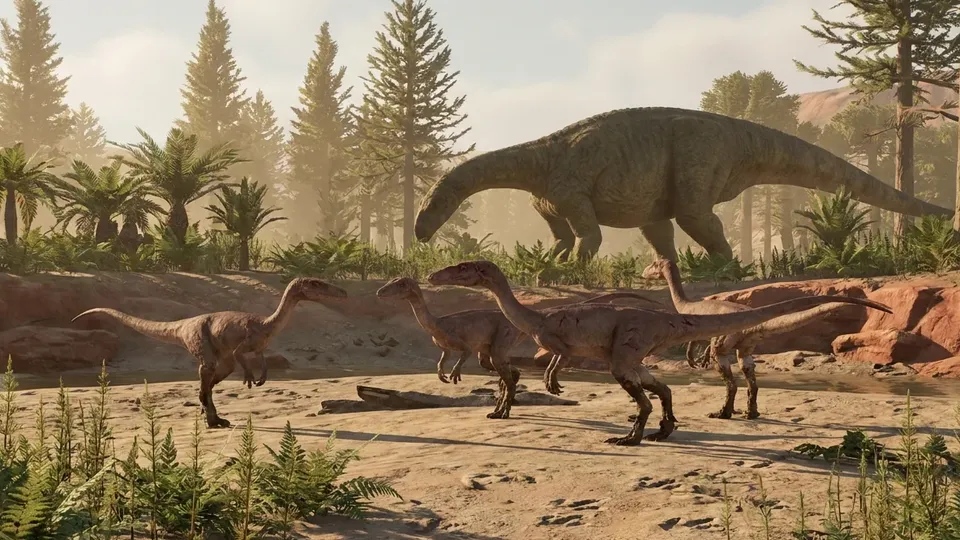
There was no grass and there were no flowering plants. Any reconstruction that shows a Triassic dinosaur on a grassy meadow is wrong: the ground was bare soil, sand, ferns and low shrubs.
Animals of the Triassic
The Triassic was a time of experiments. The animal that ruled most Late Triassic landscapes was not a dinosaur but a pseudosuchian, a relative of crocodiles. Dinosaurs started small and only became dominant after the extinction that ended the period. In the seas, marine reptiles evolved for the first time and some grew enormous.
A dog-sized early dinosaur from Ischigualasto, Argentina, about 231 million years old. One of the oldest dinosaurs known.
A predator up to about 6 m long from the same rocks as Eoraptor, among the first large meat-eating dinosaurs.
A slender, fast predator about 3 m long. Hundreds of skeletons were found together at Ghost Ranch, New Mexico.
A plant-eater up to about 8–10 m long from Germany and Switzerland, an early relative of the giant sauropods.
A large predator from North America, around 4–5 m long. Despite looking like a dinosaur, it was closer to crocodiles.
Long-snouted river predators that looked like modern gharials, common in Late Triassic rivers and lakes.
Armoured, mostly plant-eating crocodile relatives with a pig-like snout and rows of bony plates.
A giant ichthyosaur from Nevada, around 15 m long. Some Triassic ichthyosaurs were even larger.
A long-necked marine reptile with webbed limbs, an early relative of the plesiosaurs.
A stocky marine reptile with flat, crushing teeth for eating shellfish.
One of the earliest pterosaurs, from about 210 million years ago in northern Italy.
One of the earliest turtles with a complete shell, from Germany.
A shrew-sized mammaliaform from the very end of the Triassic, close to the origin of true mammals.
A giant, flat-headed amphibian about 2 m long, described in 2015 from a bonebed in the Algarve, Portugal.
Animals with a “Read the full profile” link have their own illustrated article. More are added with each new documentary.
Where its fossils are found
- Ischigualasto, Argentina. A UNESCO World Heritage Site with some of the oldest dinosaurs known, including Eoraptor and Herrerasaurus.
- Ghost Ranch, New Mexico, USA. A quarry packed with hundreds of Coelophysis skeletons, one of the richest dinosaur bonebeds in the world.
- Petrified Forest, Arizona, USA. Giant fossil logs and the remains of phytosaurs, aetosaurs and early dinosaurs.
- Germanic Basin, Germany and Switzerland. The rocks that gave the period its name, with many Plateosaurus skeletons from sites such as Trossingen.
- Monte San Giorgio, Switzerland and Italy. A UNESCO World Heritage Site famous for beautifully preserved Middle Triassic marine reptiles and fish.
- Algarve, Portugal. A bonebed near Loulé with hundreds of bones of the giant amphibian Metoposaurus algarvensis.
How the Triassic ended
The Triassic ended about 201.4 million years ago with one of the five great mass extinctions. As Pangaea began to split, enormous volcanic eruptions known as the Central Atlantic Magmatic Province poured out lava across what are now the Americas, Africa and Europe. The gases they released changed the climate and the chemistry of the oceans.
Many groups vanished, including most crocodile relatives, the giant amphibians and many marine animals. Dinosaurs survived, and with their rivals gone they spread rapidly in the Jurassic. The Atlantic Ocean later opened along the same line of rifting.
Key points for your test
- The Triassic lasted from about 252 to 201 million years ago, the first period of the Mesozoic Era.
- It started after the end-Permian extinction, the largest mass extinction ever.
- All land formed one supercontinent, Pangaea, with a hot and dry interior.
- Plants were conifers, cycads, ginkgos, seed ferns, ferns and horsetails. There was no grass and no flowers.
- The first dinosaurs appeared about 230 million years ago, along with the first pterosaurs, turtles and mammal relatives.
- It ended with the end-Triassic extinction, linked to huge volcanic eruptions as Pangaea began to split.
Sources
- International Commission on Stratigraphy. International Chronostratigraphic Chart.
- Encyclopaedia Britannica. Triassic Period.
- UNESCO World Heritage Centre. Ischigualasto / Talampaya Natural Parks.
- UNESCO World Heritage Centre. Monte San Giorgio.
- Brusatte et al. (2015). A new species of Metoposaurus from the Late Triassic of Portugal. Journal of Vertebrate Paleontology.
- Dal Corso et al. (2020). Extinction and dawn of the modern world in the Carnian (Late Triassic). Science Advances.
- Blackburn et al. (2013). Zircon U-Pb geochronology links the end-Triassic extinction with the Central Atlantic Magmatic Province. Science.