Almost everything we know about prehistoric life comes from fossils: the preserved remains or traces of organisms that lived long ago. Becoming a fossil is rare. Most animals and plants rot, are eaten or are broken apart long before they can be preserved. Here is how the few that survive are made, and how we know their age.
From animal to fossil
The classic route starts with quick burial. An animal dies in or near water, and its body is covered by mud, sand or volcanic ash before scavengers and decay destroy it. The soft parts usually rot away, leaving bones, teeth or shells.
Over thousands to millions of years, more layers of sediment pile on top and harden into rock. Water carrying dissolved minerals seeps through the buried bones, filling the tiny spaces inside them and sometimes replacing the original material, a process called permineralisation. The fossil becomes stone in the shape of the bone. Much later, uplift and erosion can bring it back to the surface, where someone may find it.
Types of fossils
- Body fossils are the remains of the organism itself: bones, teeth, shells, wood or leaves.
- Moulds and casts form when the original dissolves away, leaving a hollow in the rock (a mould) that may later fill with minerals (a cast).
- Trace fossils record behaviour rather than the body: footprints, burrows, bite marks, eggs, nests and fossil droppings called coprolites.
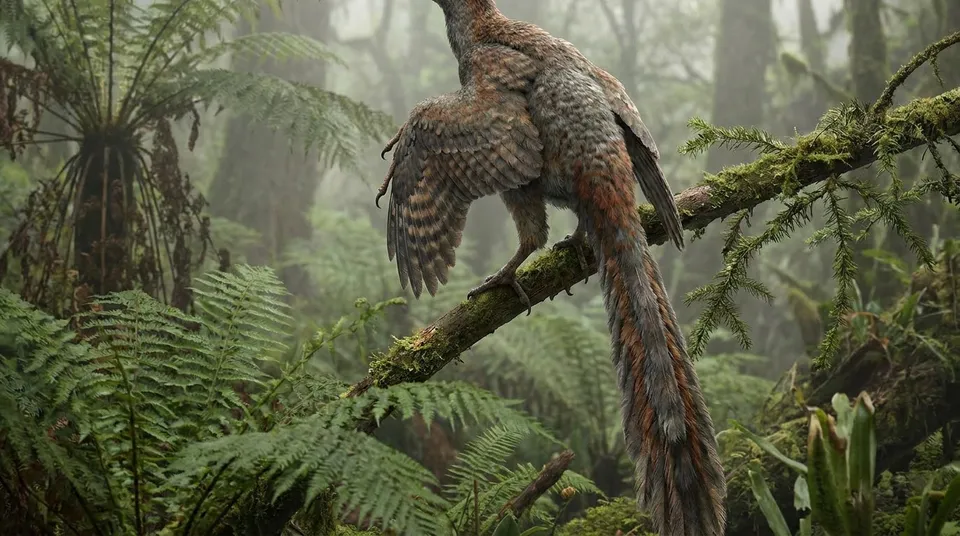
- Exceptional preservation in amber, permafrost, asphalt or very fine sediment can keep skin, feathers, fur, insects and even stomach contents.
Windows into the past
A few places preserve fossils in extraordinary detail. Geologists call them Lagerstätten, a German word for “storage places”. Examples include the Burgess Shale in Canada, with soft-bodied animals from the Cambrian; the Solnhofen limestone in Germany, which preserved the feathers of Archaeopteryx; the Jehol beds in China, with feathered dinosaurs; and the La Brea Tar Pits in Los Angeles, with millions of Ice Age bones. Mummified mammoths found in the frozen ground of Siberia and Canada are another kind of exceptional preservation.
How old is it? Relative dating
In undisturbed layers of sedimentary rock, older layers lie below younger ones. This principle of superposition, described by Nicolas Steno in the 17th century, lets geologists say whether one fossil is older or younger than another.
Some fossils are especially useful as markers. Index fossils come from species that lived for a short time but spread widely, such as many ammonites. Finding the same index fossil in rocks on different continents shows that those rocks formed at about the same time.
How old is it? Radiometric dating
To get an age in years, scientists use radioactive elements, which decay into other elements at a known, steady rate. By measuring how much of the original element remains compared with its decay product, they can calculate how long ago a mineral formed.
Fossils themselves usually cannot be dated this way. Instead, scientists date layers of volcanic ash above and below the fossil, often using uranium–lead dating of tiny zircon crystals or argon–argon dating. This gives a time window for when the animal lived.
A common mistake: dinosaurs are not dated with carbon-14. Radiocarbon dating only works for remains up to about 50,000 years old, so it is used for Ice Age animals and archaeological sites, not for fossils millions of years old.
Key points for your test
- Fossils usually form when remains are buried quickly in sediment.
- In permineralisation, minerals fill and replace the original material.
- Trace fossils record behaviour: footprints, burrows, coprolites.
- Superposition: in undisturbed rock, deeper layers are older.
- Index fossils help match rocks of the same age in different places.
- Radiometric dating of volcanic layers gives ages in years; carbon-14 only works up to about 50,000 years.
Sources
- United States Geological Survey. Geologic time and dating.
- Natural History Museum, London. How are fossils formed?
- Briggs (2003). The role of decay and mineralization in the preservation of soft-bodied fossils. Annual Review of Earth and Planetary Sciences 31.
- International Commission on Stratigraphy. International Chronostratigraphic Chart.